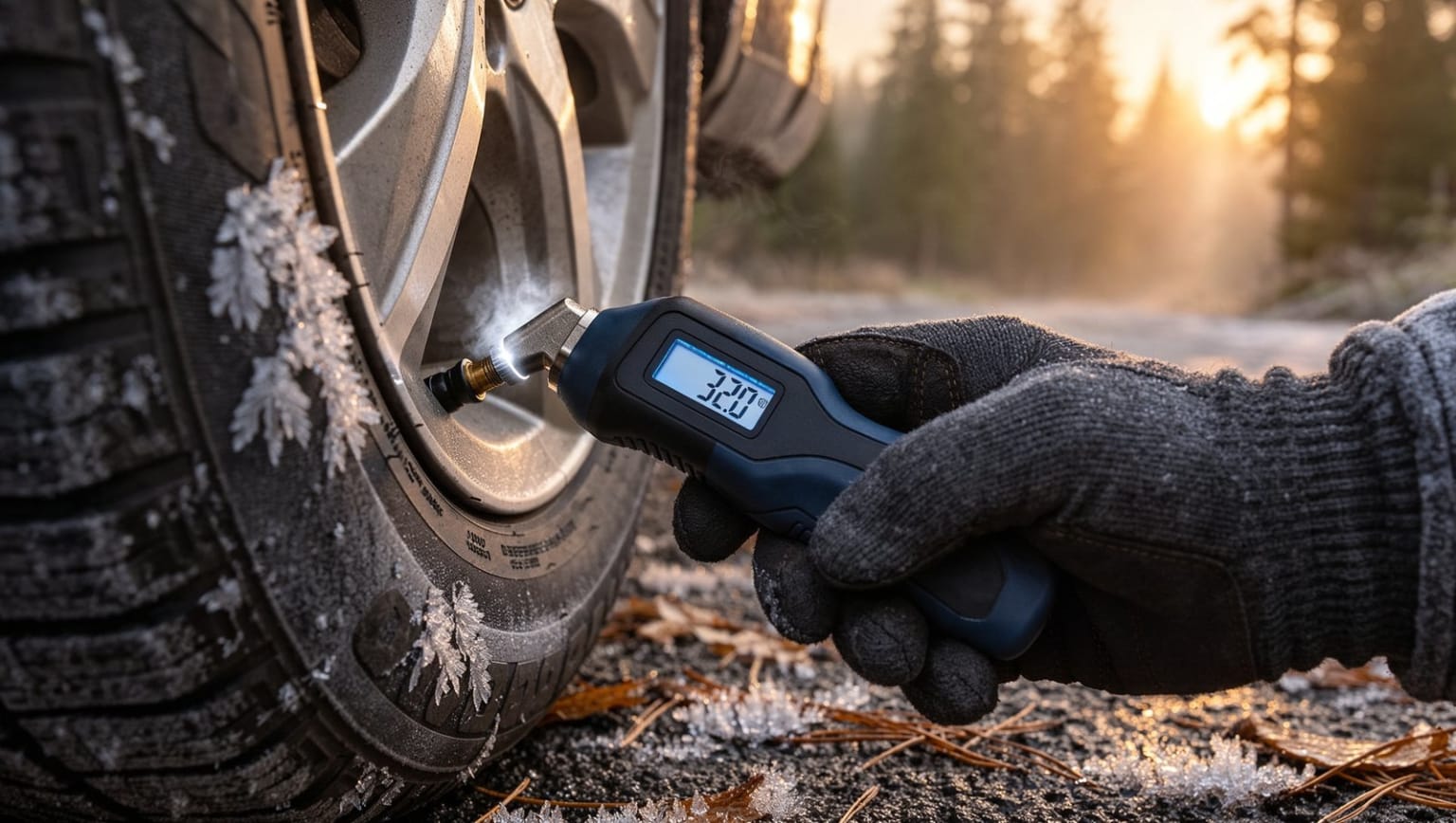
Why Your Tire Pressure Light Comes On When It’s Cold
Short answer: Cold air makes the air inside your tires contract, so the pressure drops. The 2021 Ram 1500 owner's manual puts it at about 1 psi for every 12°F. If a tire was already a little low, one cold night can push it under the warning limit, and the tire pressure light comes on. Check all four tires with a gauge, fill them to the cold pressure on the label in your driver's door jamb, and the light should go out after a short drive. If the light flashes for about a minute when you start the vehicle and then stays on, that points to a problem with the monitoring system, not just low air.
Why cold weather turns on the tire pressure light
Your tire pressure monitoring system (TPMS) compares each tire to the recommended cold pressure for your vehicle. When the temperature falls, so does the pressure in every tire.
The Ram 1500 owner's manual gives a worked example. Say your recommended cold pressure is 30 psi, and on a 68°F day a tire reads 27 psi. If the temperature drops to 20°F, that tire falls to about 23 psi, which is low enough to turn on the warning light. Driving can warm the tire back up to about 27 psi, but the light stays on until the tire is filled to the recommended cold pressure.
The National Highway Traffic Safety Administration (NHTSA) describes the same thing. On cold mornings the TPMS light may come on for a short time and then turn off. That usually means the pressure was only a little low. It dipped below the warning point overnight and came back up as the tires warmed. NHTSA's advice: if the light goes on and off, check your tire pressure. The light shouldn't come on when the tires are properly inflated.
Two more things make the first cold mornings of the season a common time for the light:
Tires lose some air naturally. The owner's manual notes the TPMS will warn you about low pressure from any cause, including cold temperatures and normal air loss through the tire. A small loss you didn't notice in warm weather can show up on the first cold morning.
The light isn't a hair trigger. Under the federal TPMS standard, FMVSS No. 138, the light must come on within 20 minutes once a tire is 25% or more below the recommended cold pressure (or a minimum level set in the standard, whichever is higher). So when it's on, at least one tire is really low.
Solid light vs. flashing light: what it means
What you see | What it usually means | What to do |
|---|---|---|
Light stays on (many models also show which tire is low or an "Inflate to XX" message) | One or more tires are below the low-pressure warning limit | Check all tires with a gauge and fill to the door-jamb pressure |
Light comes on during a cold morning, then goes off as you drive | Pressure is a little low and dips below the limit when it's cold | Check the tires cold and top them up |
Light flashes for about a minute at start-up, then stays on (some models show "SERVICE TPM SYSTEM") | The TPMS has a fault and may not be able to warn you about low pressure | Have the system checked |
The federal standard says a combined low-pressure/malfunction light must flash for 60 to 90 seconds when the system has a fault, then stay on. The 2021 Ram 1500 manual says its light flashes for 75 seconds. Check your own owner's manual for what your dashboard shows.
Where to find the right tire pressure
Look on the driver's door jamb. The Tire and Loading Information placard is on the driver's side B-pillar (the door jamb) or on the rear edge of the driver's door, according to both NHTSA and the owner's manual. It lists the cold pressures for the front, rear and spare tires.
Don't use the number on the tire. NHTSA says the correct pressure is the one your vehicle's manufacturer lists, not the one printed on the tire. The sidewall number is the tire's maximum, and the owner's manual says cold pressure must never go above it.
Front and rear can be different. Read both numbers on the placard.
Different tires? If your tires aren't the size shown on the placard, the owner's manual says you need to find the right pressure for those tires.
Driving a Ram 1500? See our Ram 1500 tire pressure guide. For any Chrysler, Dodge, Jeep or Ram, you can look up your owner's manual on Mopar's owner's manual page.
How to check and fill your tires
Check them cold. "Cold" means the vehicle hasn't been driven for at least three hours, or has been driven less than 1 mile after sitting that long. First thing in the morning is easiest.
Use a real gauge. NHTSA recommends keeping a tire pressure gauge in your vehicle. The owner's manual says not to use the dashboard TPMS display as a gauge while filling unless your vehicle has the Tire Fill Alert feature.
Compare each tire to the placard. The difference is how many psi you need to add.
Filling up at the gas station? Your tires are warm by then. NHTSA says to fill them to the recommended cold pressure anyway. A slightly low warm tire is safer than a badly underinflated one. Then recheck when the tires are cold and adjust. The Ram 1500 manual adds that with warm tires you may need up to 4 psi more than the placard pressure to turn the light off. Never go above the maximum on the sidewall.
Put the valve caps back on. The owner's manual says the caps keep moisture and dirt out of the valve stem, which could damage the TPMS sensor.
Drive to reset the light. The system updates on its own. Per the owner's manual, you may need to drive for up to 20 minutes above 15 mph before the light goes off.
Don't forget the spare. NHTSA says to check the spare, too. On many vehicles the spare has no TPMS sensor, so the system can't watch it for you.
Some vehicles have Tire Fill Alert, which lets you know when a tire reaches the placard pressure while you're filling it. See your owner's manual to find out whether yours has it and how to use it.
When it's a sensor or system problem
If the light flashes and then stays on, the system has a fault. The 2021 Ram 1500 owner's manual lists common causes:
Radio interference from electronic devices, or driving near places that send out the same frequencies as the sensors
Aftermarket window tint with materials that can block radio signals
Snow or ice packed around the wheels, or tire chains
Wheels or tires that don't have TPMS sensors
It also warns that aftermarket wheels can damage the sensors, and that aftermarket tire sealant can make a sensor stop working. After using a sealant, the manual recommends having an authorized dealer check the sensor. And after new tires or wheels go on, check that the TPMS light works the way it should.
What if the light keeps coming back after you fill the tires? A tire that keeps losing air may have a puncture, a leaking valve stem or another problem. NHTSA says to see a tire service professional if a tire won't hold its pressure or you notice noise or vibration.
Before you hit the road for the holidays
A long holiday drive is a good time for a quick tire check:
Pressure: Check all tires, including the spare, when they're cold. NHTSA recommends doing this at least once a month.
Tread: NHTSA says tires should be replaced when the tread is down to 2/32 of an inch. For the penny test, put a penny in the tread with Lincoln's head upside down and facing you. If you can see the top of his head, it's time for new tires.
Damage: Look for cuts, cracks or bulges in the sidewall.
Recalls: Tires get recalled, too. Search for vehicle and tire recalls on NHTSA's recall lookup, and see our guide to open Jeep and Ram recalls.
Load: Packing heavy? The door-jamb placard also lists the total weight your vehicle can carry.
For more cold-weather prep, see our seasonal maintenance tips. To make your tires last longer, read how often to rotate your tires and alignment vs. balancing.
FAQ
Why does my tire pressure light come on when it's cold?
Cold weather lowers tire pressure, by about 1 psi for every 12°F according to the 2021 Ram 1500 owner's manual. If a tire was already a little low, the drop can push it below the warning limit. Check and fill the tires to the door-jamb pressure.
Why does my tire pressure light go off after I drive for a while?
Driving warms the tires and raises the pressure, so a tire that's only a little low can climb back above the warning point. It's still low when it's cold, so check it and fill it to the recommended cold pressure.
Is it safe to drive with the tire pressure light on?
The light means at least one tire is significantly underinflated. Stop and check your tires as soon as you can. Driving on a badly underinflated tire can make it overheat and fail, and it can affect handling and braking. Don't drive on a tire that looks flat.
What PSI should my tires be in cold weather?
Use the cold pressure on the Tire and Loading Information placard on the driver's door jamb, measured before you drive. Don't use the maximum printed on the tire's sidewall, and never go above it.
Why is my tire pressure light flashing?
On vehicles with one combined light, flashing for about a minute at start-up and then staying on means the tire pressure monitoring system has a fault. It may not be able to warn you about low pressure until it's fixed, so have it checked.
How long does it take for the tire pressure light to go off after filling the tires?
The light turns off once the system reads the new pressures. According to the 2021 Ram 1500 owner's manual, you may need to drive for up to 20 minutes above 15 mph.
Where is the tire pressure sticker on my vehicle?
On most vehicles, it's on the driver's side door jamb (the B-pillar) or on the rear edge of the driver's door. Your owner's manual also lists it.
Get your tire pressure light checked at Liberty
If the light flashes, keeps coming back, or a tire won't hold air, let the factory-trained technicians at the Liberty CDJR service center take a look. You can schedule a service appointment online, and we offer Saturday service. Call our service department at (912) 581-3441 or visit us at 750 W. Oglethorpe Hwy., Hinesville, GA 31313, close to Fort Stewart.
Facts checked Nov. 26, 2026, against NHTSA, the federal TPMS standard (FMVSS No. 138) and the 2021 Ram 1500 owner's manual. Your own owner's manual is the final word for your vehicle. This is general information, not a diagnosis.