Ram 1500 Tire Pressure: What Owners Should Set and Why
Set your Ram 1500’s cold tire pressure to the value printed on your vehicle’s tire placard — not a number you found online, not what the last gas station attendant guessed, and not the maximum stamped on the tire sidewall. Many Ram 1500 factory street tire setups commonly have cold tire pressures around typical numbers, but the exact value varies. Your actual number depends on your trim, axle configuration, and tire size, and the tire placard is the authoritative source for every one of those variables.
Cold PSI means pressure measured after the truck has sat for at least 3 hours or been driven less than 1 mile.
The placard lists separate front and rear values — they are often different.
TPMS “Inflate to XX” messages reference your placard cold value directly.
Key Takeaways
The placard cold value is the only correct starting point for Ram 1500 tire pressure — every other number is either a rough example or a maximum limit, not an operating target.
Point | Details |
|---|---|
Placard is the authority | Set cold PSI to the driver-door placard value for your trim and tire size, not a universal number. |
Cold means cold | Measure after ≥3 hours parked; warm tires read higher and will leave you underinflated once they cool. |
Temperature shifts pressure | Expect ~1 psi change per 12°F; check monthly and before every towing run or long trip. |
TPMS needs a drive to update | After inflating to placard value, drive ~20 minutes above 15 mph for sensors to transmit and clear the warning. |
Libertychryslerdodgejeep service | TPMS diagnostics, sensor replacement, and placard-based pressure checks available for Ram owners. |
Table of Contents
Where to find the correct Ram 1500 tire pressure for your truck
What underinflation and overinflation actually do to your truck
How the Ram 1500 TPMS works and what to do when the light stays on
Spare tire and sidewall maximums: the limits you cannot ignore
Where to find the correct Ram 1500 tire pressure for your truck
The placard lives on the driver-side door B-pillar (the rear edge of the driver door, visible when the door is open). Some Ram configurations also carry tire information inside the fuel filler flap or in the glove box. The placard shows:
Recommended cold inflation for front tires
Recommended cold inflation for rear tires
Spare tire pressure (if applicable)
Tire size for each position
Maximum vehicle load rating
Your owner’s manual expands on the placard with load-specific tables and explains how values shift when you move to a different axle ratio or tire size. If your Ram has been fitted with a non-OEM tire size, the placard value may no longer apply — that is when you call the tire installer.
Pro Tip: Photograph the placard and save it in your phone. When you are at a gas station before a towing trip, you will have the exact numbers without crawling around the door frame.
How to measure cold tire pressure correctly
What “cold” actually means
Per the 2022 Ram 1500 Owner’s Manual, cold inflation pressure is the pressure after the vehicle has not been driven for at least 3 hours, or has been driven less than 1 mile after sitting for 3 or more hours. Driving heats the air inside the tire, which raises pressure by several psi. Checking a warm tire and inflating it to the placard value will leave you underinflated once it cools.
One nuance worth knowing: if you check pressure in a heated garage but the truck spent the night outside in cold weather, the reading may not reflect true ambient cold pressure. Correct for that difference when it matters.
Step-by-step check and inflate
Park and wait. Let the truck sit for at least 3 hours, or use it only for the short drive to a gas station with a compressor.
Use a quality gauge. A digital gauge (such as an Accutire MS-4021B or similar) or a quality dial gauge reads more accurately than the cheap pencil-style gauges common at gas stations. Keep one in the truck.
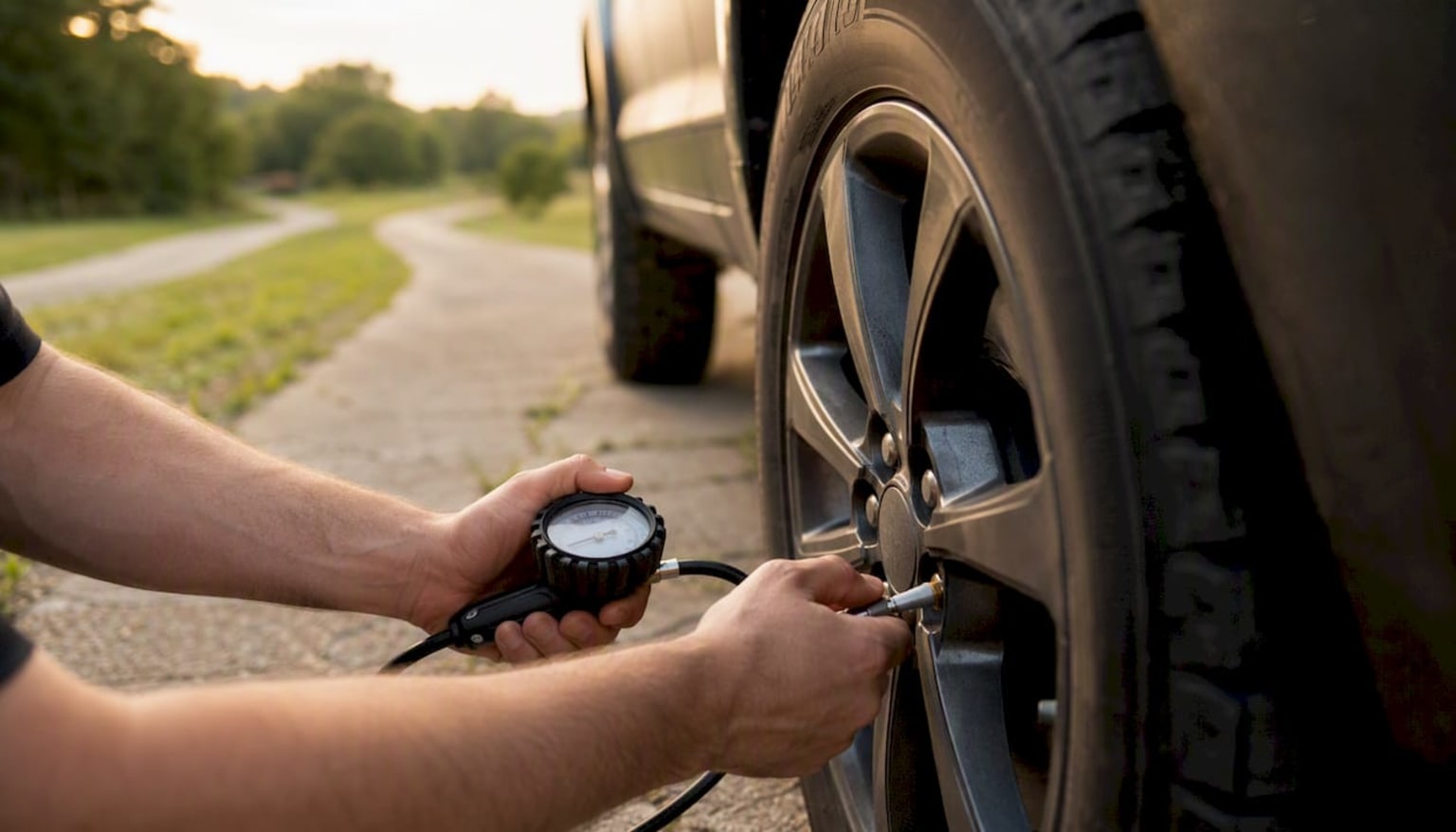
Remove the valve cap and press the gauge firmly and squarely onto the valve stem. A hissing sound means the seal is off — reseat and retry.
Record the reading for each tire before adjusting anything.
Compare to the placard. Note which tires are low, which are high, and by how much.
Inflate or deflate to the placard value. Add air in short bursts and recheck; it is easy to overshoot.
Recheck every tire after adjusting, including the spare.
Replace valve caps snugly.
Pro Tip: Check pressures monthly and always the morning before a long trip or towing run. Morning checks, before the truck has moved, give you the most reliable cold reading.
What underinflation and overinflation actually do to your truck
Getting the Ram 1500 tire psi wrong in either direction costs you in ways that compound over time.
Underinflation is the more dangerous of the two. A low tire flexes more with each rotation, building heat faster than the rubber can dissipate it. That heat accelerates tread edge wear and raises the risk of a blowout, particularly at highway speeds. Braking distances increase, and the truck’s handling feels vague. Fuel economy drops too, because a soft tire creates more rolling resistance against the road.
Overinflation shrinks the contact patch — the footprint of rubber actually touching the pavement. The center of the tread wears faster than the edges, wet traction suffers, and the ride gets noticeably harsher. On a truck as heavy as the Ram 1500, that reduced contact patch matters in emergency braking.
For daily driving, staying within a couple of psi of the placard value is the practical target. The temperature rule is worth memorizing: tire pressure changes approximately 1 psi for every 12°F of air temperature change. A truck sitting at 36 psi on a 70°F afternoon can read closer to 33 psi on a 34°F morning — still within a safe range, but worth topping off before a long drive.
Adjusting tire pressure for towing and heavy payloads
Towing changes the load on your tires, which changes what the correct pressure is. The Ram tire loading guidance is explicit: use the placard and owner’s manual for load-specific cold inflation values rather than applying a single blanket number.
Estimate or weigh your payload. Tongue weight, bed load, and passenger weight all count. If you regularly tow the same trailer, weigh it once and record the number.
Consult the placard and owner’s manual for the load-specific recommendation. Some Ram configurations list alternate rear pressures for loaded conditions.
Inflate to the specified value cold, before hitching the trailer or loading the bed.
Check front tires too. A heavy tongue weight transfers load forward; front pressure matters more than most owners realize.
If you have aftermarket or plus-size tires, the OEM placard values may not apply. Get the correct inflation from the tire installer and re-calibrate TPMS where required.
Pro Tip: Keep a small notepad or note in your phone with the settings you used for each trailer — truck PSI front and rear, gross trailer weight, and any placard notes. Repeat towing trips become much faster to set up safely. For more on matching your Ram to its load limits, the Ram towing capacity guide at Libertychryslerdodgejeep covers payload scenarios in detail.
How the Ram 1500 TPMS works and what to do when the light stays on
The basics
Wheel-mounted sensors transmit tire pressure readings to the vehicle’s ECU while the truck is in motion. Premium Ram systems display exact PSI for each position on the instrument cluster; base systems show a low-pressure warning light. Either way, the threshold that triggers a warning is tied to the placard cold value.
When you see an “Inflate to XX” message, that XX is your placard cold pressure. The Ram premium TPMS documentation explains that after you inflate, the system may need up to about 20 minutes of driving above approximately 15 mph to receive updated readings from the sensors and clear the warning.
What to do when the TPMS light won’t go away
Inflate all four tires to the placard cold value. Do not guess — check each one with a gauge.
Drive for 15–20 minutes at speeds above 15 mph. Sensors transmit periodically; the ECU needs to receive updated readings from all four wheels.
Recheck the cluster. If the light clears, you are done.
If the light persists, the cause is likely not PSI. Common culprits:
A slow leak or puncture keeping one tire below threshold
A sensor with a dead or dying battery (TPMS sensor batteries are non-serviceable and last approximately 10 years)
A wheel swap or tire change where sensors were not reprogrammed to the ECU
Aftermarket wheels with incompatible or missing sensors
When reprogramming is needed after a wheel or sensor change, a TPMS diagnostic tool plus an OBDII adapter is typically required to map sensor IDs to the ECU. The ATEQ TPMS diagnostic guide for Ram 1500 covers the activation, programming, and OBDII mapping steps in detail. That process is straightforward for a shop but not something most owners should attempt without the right tool.
Spare tire and sidewall maximums: the limits you cannot ignore
The tire sidewall carries a maximum inflation pressure molded directly into the rubber. Per the Ram 1500 owner documentation, that number is the tire’s absolute cold pressure ceiling — not the recommended operating pressure. Never inflate any tire to its sidewall maximum for normal driving; the placard value is always lower, and for good reason.
A matching full-size spare on a Ram 1500 often has its own TPMS sensor. A low spare may not trigger a dashboard warning unless it is installed in place of a road tire, so check it during your monthly routine.
A compact spare (if equipped) has its own pressure specification, usually printed on the sidewall or a label on the wheel. It also carries speed and distance restrictions — typically 50 mph maximum and limited mileage — that the full-size tires do not.
Never exceed the sidewall maximum on any tire, regardless of load or towing conditions.
Ongoing tire pressure maintenance: a practical checklist
Tire pressure is not a set-it-and-forget-it task on a truck that sees temperature swings, towing, and varying loads.
Check cold PSI monthly and before every long trip or towing run.
Expect roughly 1 psi of change per 12°F of temperature swing — a common occurrence between seasons and even between morning and afternoon in many U.S. climates.
Inspect valve stems for cracks or corrosion when you check pressure; a leaking stem is a slow drain that is easy to miss.
Look at tread wear patterns. Edge wear points to chronic underinflation; center wear suggests chronic overinflation. Either pattern means you have been running off-placard longer than you realized.
Rotate tires per the manufacturer’s schedule and ask the shop to check and set pressures to placard values at every rotation.
Replace TPMS sensors during warranted service cycles or when a sensor fault is confirmed — not just when the battery warning appears, since the battery is non-serviceable.
Pro Tip: Pair tire pressure checks with your monthly fluid check. Both take under five minutes and catching a slow leak early is far cheaper than a roadside blowout or a ruined tire.
Proper tire pressure also affects suspension wear — underinflated tires transfer more shock to the suspension components. Learn more about the vehicle ownership lifecycle on how to sell your truck in Alberta. The Ram suspension maintenance guide at Libertychryslerdodgejeep covers how these systems interact.
What the manufacturer documentation actually says
The core rules come directly from Ram and Mopar sources, not from forum consensus or generic tire guides.
Rule | Source Guidance |
|---|---|
Cold inflation definition | Parked ≥3 hours or driven <1 mile after 3+ hours |
Placard authority | Manufacturer-recommended cold pressure for your specific trim, axle, and tire size |
TPMS update time | Drive up to ~20 minutes above ~15 mph after inflating for sensors to transmit updated readings |
Temperature rule | ~1 psi change per 12°F of air temperature change |
Sidewall max | Molded on the tire; must never be exceeded; placard values are always lower |
The 2022 Ram 1500 Owner’s Manual defines cold inflation pressure and documents the TPMS behavior and temperature guidance. The Ram premium TPMS documentation confirms the ~20-minute drive requirement for system updates. These are not approximations — they are the governing rules for your truck.
What service technicians see most often
The most common tire pressure mistake is not dramatic. Owners check the tires visually, decide they look fine, and skip the gauge. A tire can lose 5–6 psi and still look fully inflated to the eye, especially on a truck with stiff sidewalls like the Ram 1500. By the time it looks low, it has been underinflated for weeks.
The second most common issue is a TPMS light that stays on after inflation because the owner did not drive long enough for the sensors to update. Inflate to the placard cold value, drive for 20 minutes above 15 mph, and the light clears in most cases. When it does not, the truck needs a sensor scan. A persistent warning after correct inflation almost always means a sensor fault, a dead battery, or a mapping problem from a recent wheel change — none of which resolve themselves.
If your TPMS light stays on after you have inflated correctly and driven the required distance, that is the right time to bring the truck in. Sensor replacement and TPMS programming after wheel changes require a diagnostic tool that maps sensor IDs to the ECU, a step that is not optional.
Accurate tire pressure service at Libertychryslerdodgejeep
Correct tire pressure on a Ram 1500 is straightforward when you have the right tools and the placard values in hand. When the TPMS light stays on, a sensor needs replacement, or you have just changed to a new wheel and tire combination, the diagnostic side gets more involved.
Libertychryslerdodgejeep’s service team handles tire pressure checks, TPMS diagnostics, sensor replacement, and TPMS programming after wheel or tire changes for Ram owners. If you are setting up for a towing season or dealing with a persistent warning, the team can confirm correct placard-based pressures and clear sensor faults with the proper diagnostic equipment. Ram warranty and Mopar parts support are available for sensor replacements. Browse the current new Ram 1500 inventory or book a service appointment directly at Libertychryslerdodgejeep to get your pressures set right before your next trip.
Sources
2022 Ram 1500 Owner’s Manual (tire pressure and TPMS sections)
Ram 1500/2500/3500 - Tire Loading And Tire Pressure - Tire Safety Information
TPMS Tire Pressure Monitoring System for Ram 1500 | Modern Tire Dealer