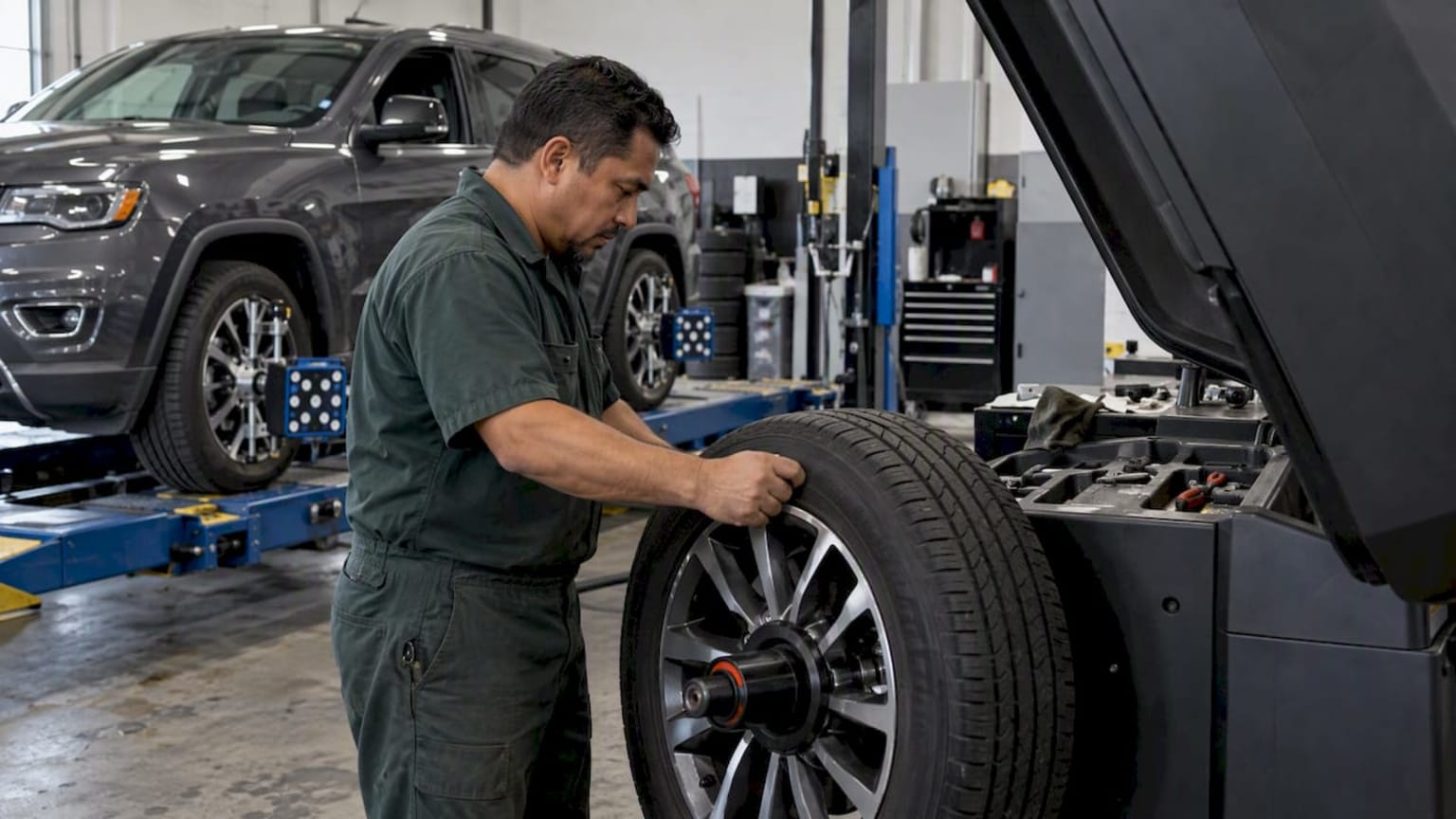
Alignment vs Balancing: What Each Fixes and When
Wheel alignment and tire balancing are two different jobs. Alignment adjusts the suspension angles so your wheels point straight and meet the road correctly. Balancing corrects uneven weight in each tire-and-wheel assembly so it spins without wobbling. Pulling and a crooked steering wheel point to alignment. A shake at highway speed points to balancing. Many drivers need both at some point, usually when new tires go on.
This guide explains how each service works, how to read your symptoms, what order to do things in, what they cost in the U.S., and when to schedule them.
Libertychryslerdodgejeep
libertychryslerdodgejeep.com
Get a Smoother, Straighter Ride
Liberty Chrysler Dodge Jeep Ram provides professional vehicle service to help address alignment and tire balance concerns.
TL;DR
Alignment sets the angles of the wheels (camber, toe and caster) so the tires contact the road correctly. It targets pulling, off-center steering and uneven tread wear.
Balancing adds small weights so the tire-and-wheel assembly rotates evenly. It targets vibration, especially at highway speed.
Get an alignment with new tires and after a hard pothole or curb hit. Balance when you mount tires or when vibration shows up.
Typical U.S. cost: alignment runs $100 to $200, and balancing runs roughly $27 to $34 per tire.
A vibration is not always a balance problem. If a balance does not cure it, ask for the tires and suspension to be inspected.
Table of Contents
Alignment vs balancing at a glance
The quickest way to keep them apart: alignment is about direction, balancing is about rotation. Michelin describes it this way: alignment controls where the tire points and how it contacts the road, while balancing controls how the tire rotates once it is moving.
Wheel alignment | Tire balancing | |
|---|---|---|
What it corrects | Wheel angles set through the suspension | Uneven weight in the tire-and-wheel assembly |
How it is done | Suspension is adjusted to the manufacturer’s specifications | Small weights are added to the wheel on a balancing machine |
Typical symptom | Pulling, crooked steering wheel, wandering steering, uneven edge wear | Vibration in the steering wheel, seat or floor at certain speeds |
Main benefit | Straight tracking, steering stability, even tread wear | Smooth ride, less stress on tires and suspension parts |
Needed | With new tires, after impacts, when symptoms appear | When tires are mounted, or when vibration appears |
The two are often sold together, but one does not replace the other. Bridgestone explains that balancing is commonly performed alongside alignment but is not a substitute, because the two procedures correct different physical conditions.
What wheel alignment does
Alignment does not touch the tires. It adjusts the suspension so the wheels sit at the angles the manufacturer specified. Toyota notes that these are the caster, camber and toe angles, and that the goal is correct tire-to-road contact, steering stability and even tread wear.
Bridgestone names the same three angles as the principal ones. In plain terms:
Camber is the inward or outward tilt of the wheel when you look at the car from the front.
Toe is whether the fronts of the tires point slightly toward or away from each other, like your feet.
Caster is the forward or backward angle of the steering axis, which affects steering stability and how the wheel returns to center.
When these drift out of spec, the tire no longer meets the road flat. It drags sideways or leans onto one shoulder, and the tread wears faster on that edge.
What knocks an alignment out
The U.S. Tire Manufacturers Association says a pothole or other road hazard can cause alignment problems, and that misalignment can produce uneven, rapid tread wear. Curbs, worn suspension parts and a change in ride height do the same job more slowly. If you have lifted a truck, the angles change too; our guide to post-lift alignment on lifted trucks walks through what a shop should do.
What tire balancing does
No tire and wheel is perfectly uniform. One spot is slightly heavier, and at speed that heavy spot makes the assembly hop or wobble. A technician mounts the assembly on a balancing machine, which measures the imbalance, and then adds small weights to the wheel to offset it. Bridgestone describes the correction as covering both static and dynamic imbalance.
Why it matters: Michelin points out that an assembly that does not spin evenly causes vibration and uneven wear. The shaking is felt by you, and the repeated bouncing is felt by the tires, shocks and bearings.
A small practical note: balance weights stick to the wheel, and coated or polished wheels deserve gentle care when they are cleaned. Non-acid wheel cleaners are one option for keeping a coated finish in good shape between tire services.
How to tell which one you need
The symptom is your best clue. Match what you feel to what the car is doing.
Signs that point to alignment
According to Michelin’s guidance, misalignment commonly shows up as:
a consistent pull to one side on a straight, flat road
a steering wheel that sits at an angle when you are driving straight
uneven wear on the inside or outside edge of the tread
vague or wandering steering
One detail helps avoid a wrong diagnosis. Michelin’s handling guidance says a constant pull usually points to alignment or a tire pressure or wear problem, while a pull that happens only when you brake more often means a brake issue. Check your pressures first; it costs nothing, and our Ram 1500 tire pressure guide shows how to find the right number for your truck.
Signs that point to balancing
Vibration is the main symptom. BFGoodrich says that front-end imbalance is generally felt in the steering wheel, while rear imbalance is more likely felt through the seat or floor. Cupped or scalloped wear can also point to prolonged imbalance.
Speed is the other clue. Michelin says a vibration that appears in a particular speed range and eases above or below it is a classic wheel-imbalance pattern. If your steering wheel shimmies at 60 to 70 mph and smooths out at 80, think balance first.
When it is neither
Do not assume. General Motors’ own 2024 service bulletin filed with NHTSA lists imbalance, out-of-round conditions and tire force variation as separate possible causes of a highway-speed vibration, and each may need evaluation. A bent wheel, a damaged tire, a worn suspension part or a brake problem can all feel like “needs balancing.” If a fresh balance does not cure the shake, the answer is a proper inspection, not a second balance.
Which comes first, balancing or alignment?
It depends on what you are chasing.
Chasing a vibration: balance first. The same GM bulletin says imbalance is normally addressed first when diagnosing a tire and wheel shake, because it is the simplest correction. It also warns that a balanced assembly can still be out of round or have tire force variation.
Chasing a pull or off-center wheel: align. Balancing will not change where the car tracks.
Installing new tires: the tires are mounted and balanced as part of the install, and alignment is checked at that visit so the new tread does not start wearing wrong from the first mile.
Can you balance without an alignment? Yes, and many drivers do. Can you align without balancing? Also yes. But Michelin explains that a vehicle can be aligned yet still vibrate, or be balanced yet wear unevenly from incorrect angles. Fixing one does not fix the other.
When to get each service
When to get an alignment
Kelley Blue Book recommends getting an alignment when you replace tires. It also suggests checking alignment whenever you rotate tires, about every six months or 6,000 miles, whichever comes first, and never going more than 10,000 miles without an alignment examination.
Beyond the calendar, Michelin lists these triggers: new tires, potholes, curbs or road debris, vibration, pulling or steering instability, and regular or seasonal tire maintenance. Replacing steering or suspension parts is another good moment.
When to get tires balanced
Balancing is more symptom-driven. Consumer Reports says balancing is not needed unless vibration occurs. In practice that means: at every new tire mounting, after a tire is repaired or a wheel weight falls off, and whenever you feel a speed-specific shake.
A simple schedule
New tires: balance at mounting, and have the alignment checked the same day.
Every tire rotation: ask for an alignment check if you have gone about six months or 6,000 miles.
After a hard impact: if you hit a deep pothole or a curb, watch for pulling or an off-center wheel and get it checked.
Any new vibration: note the speed range and where you feel it, then book a balance and inspection.
Changing season or tire type: swapping to all-terrain or all-season tires is a natural time to check both.
Seasonal checks fit well with our seasonal vehicle maintenance tips.
What each service costs in the U.S.
Alignment usually costs more than balancing, but balancing is charged per tire.
Service | Typical U.S. cost | Source |
|---|---|---|
Wheel alignment | $100 to $200; dealership national average $183 | |
Tire balancing | $27 to $34 per tire | |
Tire rotation and balance together | $112 to $132 |
Kelley Blue Book notes that the vehicle and your location affect the alignment price. Trucks, vehicles with adjustable suspension and lifted rigs tend to take more time. Labor rates drive much of the difference between shops, and we explain how that number works in our guide to dealership labor rates and break the alignment price down further in our wheel alignment cost guide.
A worked example: with four tires and a vehicle needing an alignment, you might pay $100 to $200 for the alignment and roughly $108 to $136 for four balances (4 x $27 to 4 x $34), so a combined visit could run from about $208 to $336 before tire cost. Many shops bundle these when tires are bought, so ask what is included at quote time.
Our perspective
Most of what we see at the service desk is not a mystery. A driver feels a shake or a pull, assumes the worst, and wants to know whether it is a big repair. The honest answer usually starts with a short conversation: where do you feel it, at what speed, and did anything happen recently, like a pothole or a new set of tires?
We think the most common mistake is treating alignment and balancing as interchangeable, or as a package every driver must buy on a schedule. They are separate fixes for separate conditions. If you have a shake and no pulling, start with balance and a tire inspection. If the car drifts and the tread is wearing on one edge, alignment is the better first stop. And if you just bought tires, make sure both were handled before you drive away.
We also say no to work you do not need. Our approach is to explain what we find, show you the reason, and let you decide. That is how we try to build the kind of long-term relationship where you come back for the next oil change and the next set of tires, not just a one-time fix.
— michael
Get it checked at our service center
If you drive a Chrysler, Dodge, Jeep or Ram and you are feeling a vibration, a pull or uneven wear, our service center can look at the tires and suspension and tell you what the symptoms point to. If a tire is worn past saving, we can help you replace it, and genuine Mopar parts and accessories are available for the repairs that follow. Tell us the speed range, where you feel the problem and when it started, so the technician knows where to look first.
If the repair bill is bigger than expected because the tires, wheels or suspension are well past their best, you also have options: a look at our new inventory or a trade-in valuation may be a smarter use of money than a string of repairs. Tire and wheel damage is a risk for any driver, and some owners weigh tire and wheel protection when they buy.
FAQ
How do I know if I need a balance or an alignment?
Look at the symptom. Pulling, a crooked steering wheel or wear on one edge of the tread points to alignment. A vibration in the steering wheel, seat or floor at certain speeds points to balancing. If you cannot tell, a technician can check both in one visit.
Should you do balance or alignment first?
If you are chasing a highway-speed shake, balance first, since GM’s bulletin calls it the simplest correction. If the problem is pulling or an off-center wheel, align first. With new tires, both are done at the same visit.
Can I do balancing without an alignment?
Yes. They are separate procedures and one does not depend on the other. But a balanced tire can still wear unevenly if the angles are off, so it is worth having alignment checked when tires are changed.
Which is more expensive, wheel alignment or balancing?
Alignment usually costs more per visit, at $100 to $200 according to Kelley Blue Book. Balancing is priced per tire at about $27 to $34 according to Consumer Reports, so four tires can come to $108 to $136.