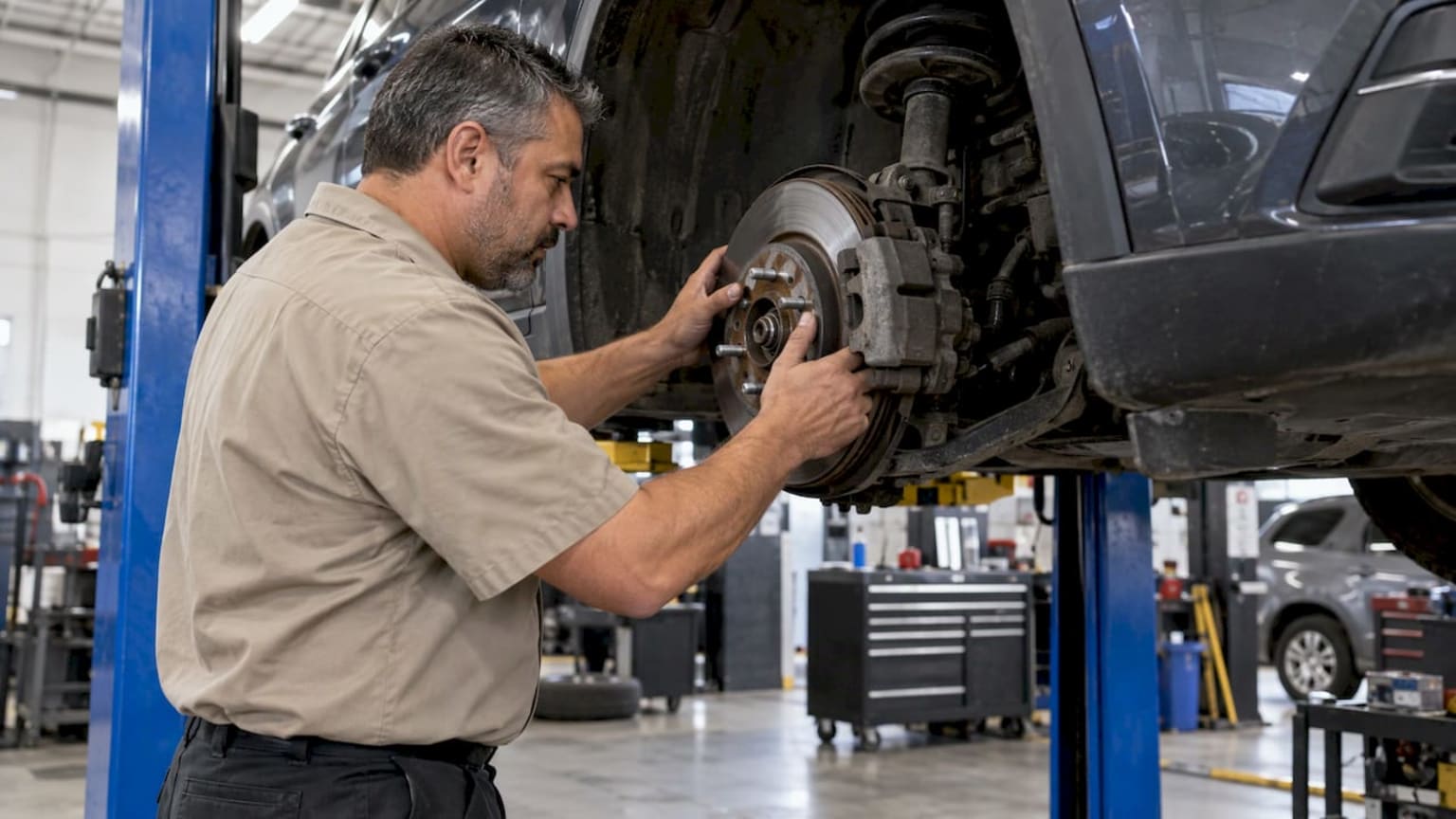
Wheel Bearing Noise Symptoms: What a Bad Bearing Sounds Like
A bad wheel bearing usually starts as a faint hum or whirr that rises and falls with your speed, then grows into a growl, and in late stages turns into clicking or popping. If the sound follows your road speed rather than your engine speed, and it changes when you steer, the bearing is the first suspect. Because a worn bearing can fail without much more warning, the safe move is to have the car inspected as soon as the noise appears. Our service center can look at the wheel end and pin down which corner is making the noise.
Libertychryslerdodgejeep
libertychryslerdodgejeep.com
Get That Wheel Noise Checked
A Liberty service professional can inspect your vehicle when a hum, growl, or other wheel noise raises concerns.
TL;DR
A wheel bearing typically starts with a hum or whirr, then a growl that gets louder as speed rises, and later clicking or popping, according to Kelley Blue Book.
The noise tracks vehicle speed, not engine speed, and it usually changes when you steer left or right.
Other signs include a vibrating steering wheel, a loose feel, uneven tire wear, grease on the wheel, and an ABS light.
Do not keep driving on a noisy bearing: it can damage other parts and affect safety.
A typical U.S. replacement averages about $350 per wheel, and luxury cars and EVs can run $700 or more.
Table of Contents
What a wheel bearing does
A wheel bearing is a ring of steel balls or rollers that sits inside the hub, the part your wheel bolts to. It lets the wheel spin freely with very little friction while carrying the weight of the vehicle. On most modern cars it comes as a sealed unit, often built into the hub assembly, packed with grease at the factory.
When the seal lets in water and grit, or the metal surfaces wear or pit from miles and impacts, the smooth rolling turns rough. Roughness is what you hear first. That is why noise is the lead symptom, and why this guide spends most of its time on sound.
What a bad wheel bearing sounds like
No two bearings sound exactly alike, but the pattern is consistent. Kelley Blue Book describes a progression: a faint hum or whirring that shifts in intensity with slight steering adjustments, then squealing or growling that grows louder as speed increases, and finally clicking or popping at lower speeds or in turns as failure advances.
Humming, whirring, and growling
This is the classic sound. Think of a low drone, like a tire with aggressive tread on coarse pavement, but with a rhythm. A Vehicle Service Pros technical article describes a cyclical growl or hum that generally gets louder the faster you go and can change as the vehicle pitches and rolls. The word “cyclical” matters: the sound pulses at the rate the wheel turns, so it speeds up as you do.
A Tomorrow’s Technician article adds that the noise can be a chirp, squeal, or growl proportional to vehicle speed, and that it may seem to vanish at certain speeds. A noise that fades in and out can still be a bearing.
Clicking and popping
Clicking or popping that shows up at low speed or in tight turns points to a bearing that has progressed further. It can also be a worn CV joint, the flexible joint at the end of a front-drive axle shaft. The two are easy to confuse, which is one reason a proper inspection beats guessing.
Squealing
A high squeal can come from a dry or damaged bearing, but it is also what worn brake pads and belts do. Squeal alone is the weakest clue. Pair it with a speed-linked hum or a change when steering and it becomes more convincing.
How the noise changes with speed and steering
This is where you can learn the most without tools.
Speed. Wheel bearing noise is usually proportional to vehicle speed. According to TechShop’s Wheel Bearings 101, it does not change whether you are accelerating, coasting, or decelerating. That separates it from differential, transmission, or U-joint noise, which tend to change with throttle or load.
Steering. Because turning shifts the vehicle’s weight onto the outside wheels, a worn bearing under extra load tends to get louder or quieter as you steer. A common rule of thumb: if the hum grows when you turn right, the load is moving to the left side, so suspect the left bearing, and the reverse for a left turn. Treat that as a lead, not a verdict. Vehicle Service Pros cautions that the side-loading test can mislead: if the damage on the rotating surface sits on the top of the bearing, it can get louder when weight comes off it.
A simple listening drive
You can gather useful notes before you call us:
Pick a smooth, quiet road with little traffic. Turn off the radio and the fan.
Note the speed at which the sound begins and whether it rises as you go faster.
Coast in neutral only if it is safe and legal where you are, or simply lift off the throttle, and see whether the sound stays tied to road speed.
On a safe, open road, make gentle lane-change style weaves left and right at a steady speed. Note which direction makes the sound louder.
Write down which side of the car the sound seems to come from, keeping in mind that noise travels through the body and can fool you.
Those notes give a technician a head start. A few minutes of careful listening beats a vague “it makes a weird noise.”
Other symptoms besides noise
Sound is not the only signal. A Porsche Club of America tech tip on failing wheel bearings lists a set of signs beyond the groan: a loose or less responsive steering feel, a soft brake pedal with more travel, very uneven tire wear, black grease stains on the wheel from a broken seal, and the ABS light coming on.
Steering feel and vibration
Excess movement at the wheel end changes the front-end geometry. Vehicle Service Pros notes that on 4WD trucks a failed bearing can mean extra steering input is needed in corners even when there is no noise or vibration. If your Ram or Jeep seems to wander or needs more correction than it used to, mention it when you book.
Vibration through the steering wheel or seat tends to arrive later in the life of a bearing, once there is measurable play. If vibration is your main complaint and it appears only in a narrow speed band, tire balance, alignment, or brakes are just as likely. Our guides on alignment versus balancing and on a steering wheel that shakes when braking help sort those out.
Soft brake pedal
A worn front bearing lets the hub and rotor wobble, which pushes the brake pads back and creates extra clearance between pad and rotor. Brake & Front End describes this as a low brake pedal on disc-brake vehicles.
Uneven tire wear and grease on the wheel
A wobbling hub wears tires unevenly, often on one corner only. If you see dark grease streaks around the hub or on the inside of the wheel, the seal may have failed. Clean the wheel first so you can see what is grease and what is dust: this walkthrough on how to remove brake dust safely shows a method that will not harm the wheel finish.
The ABS or traction control light
The wheel speed sensor reads a toothed ring, called a tone ring, that is mounted on the bearing side. The Porsche Club tip explains that when a worn bearing makes the hub wobble, the signal the computer receives goes out of range and the ABS light can come on. Kelley Blue Book also notes that a failing bearing can trigger the ABS or traction-control warning. A warning light with a growl from one corner is a strong combination.
Is it a bearing, or something else?
Several parts imitate a bad bearing. Vehicle Service Pros warns that worn tires, driveshaft hanger bearings, and CV axle support bearings are often misdiagnosed as wheel bearings. Here is how the main lookalikes differ.
Suspect | What you notice | How it differs from a bearing |
|---|---|---|
Wheel bearing | Hum or growl that rises with road speed, changes when steering | Stays tied to speed whether you accelerate or coast |
Tires (cupped or unevenly worn) | Drone or roar, often similar to a bearing | Changes with the road surface and tire rotation, and often shows in wear patterns |
Outer CV joint | Clicking or popping in turns | Per TechShop, usually noisy only when turning, not when driving straight |
Differential, transmission, U-joint | Whine or clunk | Changes with acceleration, coasting, or load |
Brakes | Squeal, grind, or pulsing | Appears or changes when you press the pedal |
Tires are the most common confusion, because a rough bearing and a cupped tire both drone at speed. A technician can rotate the tires front to back and see whether the sound moves, which is a quick, inexpensive way to separate the two.
How a technician confirms it
A good diagnosis does not rely on one test. Typical steps include a road test, a check with the wheel off the ground, and a measurement of play.
Road test. The technician listens for speed-linked noise and the effect of steering.
Hands-on check. With the wheel raised, the technician spins it by hand to feel roughness, listen for noise, and rock it to feel looseness.
Measuring play. Tomorrow’s Technician gives a rule of no more than 0.005 inches of play on good bearings, measured with a dial indicator, a precision gauge that reads tiny movement. Brake & Front End gives the same 0.005-inch limit for end play on sealed ball and tapered roller bearings.
Isolating the corner. Vehicle Service Pros describes an electronic stethoscope, sometimes called a chassis ear, with sensors clamped at each hub during a road test. Switching between them identifies which corner produces the growl, which helps avoid replacing the wrong bearing.
ABS check. Since the sensor and tone ring live at the bearing, scan tools can show whether the ABS code points to the same corner.
If you want to know what to expect when you hand over the keys, read how the dealership diagnostic process works for drivers.
Is it safe to keep driving?
No. Do not plan on driving for weeks with a bearing that is growling. Kelley Blue Book advises that driving on bad wheel bearings affects vehicle safety and could lead to a serious accident, and that a worn bearing can also damage the hub, the CV joint, or even an automatic transmission. It recommends getting them checked as soon as possible.
Stop driving and arrange a tow or a ride to the shop if you notice any of these:
Loud grinding that is getting worse by the day.
A wheel that wobbles, shakes violently, or feels loose.
Smoke or a burning smell from one wheel.
A sudden pull to one side, a very soft brake pedal, or wheel lock-up.
Do bearings give warning? Often yes, in the form of the sound progression above. The length of that warning varies with the vehicle, the load, and the road, so the noise is a prompt to act now rather than a countdown you can rely on.
What replacement costs in the U.S.
Kelley Blue Book reported in May 2025 that the average out-the-door wheel bearing replacement is about $350 per wheel before taxes, and that luxury cars and EVs can run $700 or more per wheel. Your actual quote depends on whether your vehicle uses a bolt-on hub assembly or a pressed-in bearing, whether the front or the rear is affected, and local labor rates. Parts and labor prices change over time, so ask for a written estimate for your VIN and corner.
One practical tip: bearings are not usually replaced as a pair the way brake pads are by the axle, but the wheel end is already apart for the job, so ask the technician to look at the brake pads and rotor on that corner. Our brake pad cost guide and rotor replacement versus resurfacing article explain what to expect if they are due. After suspension work, an alignment check protects your new parts and your tires.
Our perspective
Most drivers who come to us about a noise have already lived with it for a while. They turned up the radio, assumed it was the tires, and hoped it would pass. We understand why: a hum at 50 mph does not feel like an emergency.
What we want you to take from this article is that the hum is the cheap part of the story. A bearing caught early is a straightforward repair on one corner. A bearing left until it chews up the hub, the CV joint, or the ABS sensor turns into a bigger bill and a less safe car.
That is why we care about the diagnosis as much as the repair. Chrysler, Dodge, Jeep, and Ram vehicles carry different wheel-end designs, and a noise that sounds like a bearing can be a tire or a CV joint. We would rather tell you plainly what is making the sound than guess.
Our service center works on the vehicles we sell, and our parts department stocks genuine Mopar parts and accessories. If you drive a Jeep or Ram that sees heavy loads or rough roads, tell us how you use it. It helps us understand where to look.
michael
Book the inspection
If you hear a speed-linked hum, growl, or click, or you have an ABS light with noise from one corner, bring the vehicle to the Liberty Chrysler Dodge Jeep Ram service center. Tell us your notes from the listening drive: when the sound starts, which way you were turning, and which side it seems to come from.
We also offer genuine Mopar parts and accessories for repairs. If you are weighing the whole vehicle, our team can walk you through financing options and a trade-in value for your current one, or show you our certified pre-owned vehicles.
FAQ
What does a worn front wheel bearing sound like?
Typically a low hum, whirr, or growl that gets louder as you speed up and often changes when you steer. Kelley Blue Book notes the sound can progress to squealing and then clicking or popping as the bearing deteriorates. The noise usually comes from the front corner that is worn, though it can seem to come from elsewhere.
How do I tell if a wheel bearing is bad?
Listen for a rhythmic noise tied to road speed that stays the same whether you accelerate or coast, and note whether steering changes it. Look for uneven tire wear, grease around the hub, a loose steering feel, or an ABS light. A technician confirms it by spinning the wheel, checking for play, and isolating the noisy corner.
Can I drive with a noisy wheel bearing?
It is not recommended. Kelley Blue Book says driving on bad bearings affects safety and can damage the hub, CV joint, or transmission. If the noise is loud, the wheel feels loose, or you see smoke, stop driving and arrange a tow.
How much does it cost to fix wheel bearing noise?
Kelley Blue Book puts the average at about $350 per wheel before taxes in the U.S. as of May 2025, with luxury cars and EVs at $700 or more per wheel. Your price depends on the vehicle, the corner, and labor rates, so ask for a written estimate.
Sources
Kelley Blue Book: Wheel Bearing, How Do I Know if I Need a Replacement?
Porsche Club of America: Wheel Bearings, How to Tell When Yours Is Starting to Fail
Brake & Front End: Diagnostic Solutions, Wheel Bearing Diagnosis