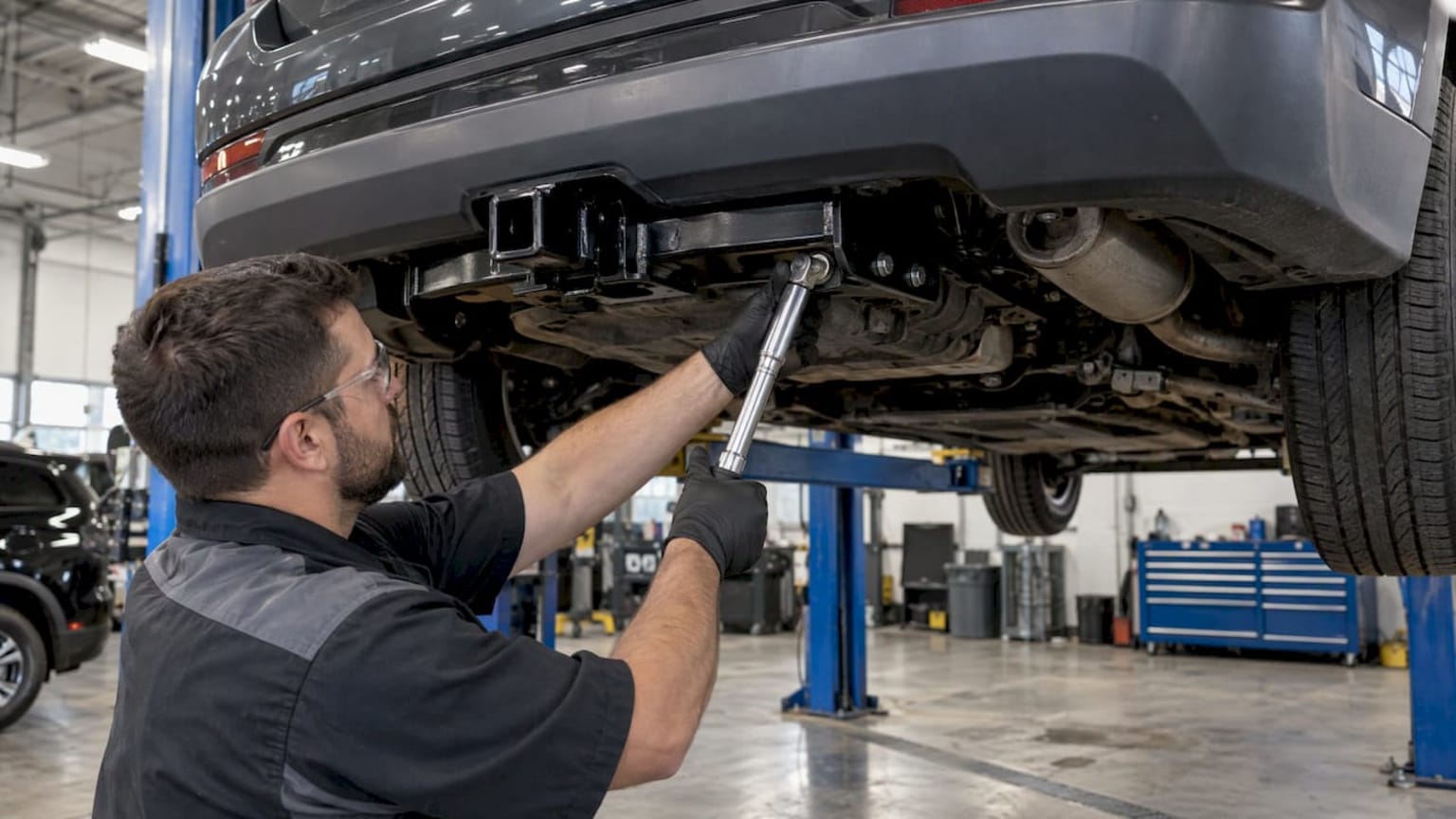
Hitch Installation Cost: What You'll Really Pay in 2026
Hitch Installation Cost: What You’ll Really Pay in 2026
Most drivers pay somewhere between $300 and $600 for a trailer hitch installed, parts and labor together. Forbes Home puts the average at $575 for a standard hitch with professional installation, with a low of $300 and a high of $1,800 for a fifth-wheel hitch. A small-car receiver can come in near $100 to $200, and a heavy-duty truck setup with wiring and a brake controller can pass $1,000.
The number you land on depends on five things: the hitch class, your exact vehicle, wiring, who does the work, and whether the job needs extras like a brake controller. This guide breaks each one into dollars so you can read a quote and know whether it makes sense.
Libertychryslerdodgejeep
Plan Your Hitch Setup With Confidence
Liberty Chrysler Dodge Jeep Ram helps drivers find the right vehicle and provides professional service after the sale.
TL;DR
Expect roughly $100 to $1,300 or more overall. Most standard receiver hitches fall between $150 and $400 for parts, plus $75 to $150 in labor.
Hitch class is the biggest price lever. Class 1 and 2 are the cheapest, Class 3 and 4 cost more, and fifth-wheel setups cost the most.
Wiring and a trailer brake controller can add a few hundred dollars. Many Jeep, Ram and Dodge vehicles already have part of this built in.
Quotes start with your year, make and model, because some vehicles need trimming, exhaust lowering or drilling.
Most receiver installs take 30 minutes to about three hours.
Table of Contents
Typical hitch installation cost in the US
Published estimates differ because they measure different jobs. A bare receiver on a compact car is cheap. A fifth-wheel kit in a pickup bed is a different project. Here is how the main sources line up.
Source | Reported range | What it covers |
|---|---|---|
$100 to $1,300 or more | Overall installation cost; most receiver hitches $150 to $400 in parts, plus $75 to $150 labor | |
$300 to $1,800, average $575 | Standard hitch with professional installation; top end is a fifth-wheel hitch | |
About $100 to $800 | Installation alone, with $150 to $200 more for the hitch and accessories |
The same This Old House guide notes that a national equipment rental company quotes an average of $100 to $600, while an auto parts retailer cites $250 to $1,300 or more. That spread is normal. The low end usually means a simple, vehicle-specific bolt-on receiver. The high end usually means a larger class, complex wiring or a fifth-wheel kit.
A practical way to use these numbers: for a common SUV or crossover with a Class 3 receiver, plan on about $300 to $600 installed. If you also need a wiring harness, add to that. If you tow something heavy enough to need a brake controller, budget separately for it.
What is in a hitch installation quote
A complete tow-ready quote has several line items. Knowing them helps you compare quotes fairly, because one shop may list a bare receiver while another includes everything.
The receiver hitch
This is the steel frame that bolts to your vehicle and accepts a ball mount. Forbes Home lists receiver prices from $120 to $1,800 or more, with the top of that range reflecting heavy-duty and specialty hitches.
Ball mount, ball, pin and clip
These are small parts, but they are what you actually tow with. Per the same Forbes Home breakdown, a hitch ball runs $10 to $50, a towing drawbar $45 to $85, a hitch pin $5 to $10 and a receiver tube cover $10 to $20. A quote that leaves these out looks cheaper than it is.
Wiring harness
Your trailer’s lights need power. Forbes Home gives a wiring harness range of $15 to $55 for the part. Labor to install it is separate, and the total grows when your vehicle needs a custom or powered converter harness.
Labor
Shop rates vary by region and by the difficulty of the job. Forbes Home reports labor for Class 1 or 2 installs averaging about $150 to $200, Class 3 or 4 about $250 to $500, and fifth-wheel installs up to $650, which works out to roughly $50 to $225 per hour depending on the shop.
How hitch class changes the price
Hitch classes are tied to how much weight you can pull. This Old House describes five classes of receiver hitches, from Class 1 hitches that handle up to 2,000 pounds on compact cars up to Class 5 commercial hitches that can tow up to 20,000 pounds behind heavy-duty trucks. In general, a higher capacity means a bigger, costlier hitch and more labor.
Class 1 and 2: Light-duty hitches for small cars, crossovers and light trailers like bike racks, cargo carriers and small utility trailers. These are the lowest-cost installs.
Class 3 and 4: The most common choice for SUVs, minivans and half-ton trucks pulling boats, campers and larger utility trailers. Expect the middle of the price range.
Class 5: Heavy-duty hitches for 3/4-ton and 1-ton trucks. Parts and labor both go up.
Fifth-wheel and gooseneck: These mount in the truck bed on rails or an under-bed system. They sit at the top of every published range, with Forbes Home citing a high of $1,800 for a fifth-wheel hitch.
Buying the class your tow rating can actually use is the smart move. Your vehicle’s tow rating is a ceiling no matter what hitch is bolted on, so match the hitch to the vehicle first and the trailer second. Our guide to GCWR vs GVWR explains the ratings that set those limits, and our Ram truck towing capacity examples show how much they vary by configuration.
Why your exact vehicle matters
Receiver hitches are mostly vehicle-specific. That is why installers and online tools start with the year, make and model. On many vehicles the hitch bolts into existing, pre-drilled holes in the frame and goes on in an hour or two. Some models are less simple: the job can involve removing the spare tire, lowering the exhaust, removing existing hardware, trimming small panels or a heat shield, or drilling into the frame, and the hardware must then be torqued to spec.
Each extra step adds labor time, which is why two quotes for the “same” Class 3 hitch can differ by $100 or more. When you ask for a quote, give the full model year, trim and drivetrain, and say what you plan to tow.
Wiring, brake controllers and other add-ons
The hitch itself lets you connect a trailer. Wiring and braking let you tow it legally and safely. This is where totals climb quickly.
Lighting connectors
A basic trailer uses a four-pin connector for taillights, brake lights and turn signals. Larger trailers often use a seven-way connector that also supports electric brakes and other circuits. Some vehicles come with a factory tow package that already includes a connector, which can save you real money. Our breakdown of Jeep tow package wiring shows what is included and what you may still need to add.
Trailer brake controllers
Trailers with electric brakes need a controller in the cab. Standalone controllers add both a part cost and labor. Some newer trucks have the controller built into the vehicle, which removes that cost entirely. If you drive one of those, our walkthrough of the integrated trailer brake controller covers how it works and how quickly it can be set up. For a plain-language explanation of what the device does and when you need one, read trailer brake controller explained.
A sample budget
Here is an illustrative way to build a total, using the ranges above. These are planning figures from the published sources, not a quote from us.
Receiver hitch, parts plus labor: $150 to $400 in parts and $75 to $150 in labor, per This Old House.
Wiring harness part: $15 to $55, per Forbes Home, plus the installer’s time.
Ball mount, ball and pin: roughly $60 to $145 combined, from the Forbes Home line items for drawbar, ball and pin.
Brake controller, if needed: priced separately and only for trailers with electric brakes.
Add those up for a typical SUV with a four-pin connection and you land close to Forbes Home’s $575 average. A bare, simple install can come in far below that. A truck with a seven-way connector and controller will come in above it.
How long does installation take?
Most receiver hitches go on quickly. This Old House says professional installs take 30 minutes to two to three hours, depending on the hitch type and how complex the vehicle is. Wiring adds time, and so does anything that requires lowering the exhaust or trimming bodywork. Fifth-wheel installs take longer because rails and mounting hardware go in the truck bed. If you are planning around a trip, book the appointment several days before you leave rather than the day before, so there is room for a wiring fix or a part that needs ordering.
Where to have it installed
The price of the same job changes with the kind of shop doing it. Here is what to weigh.
Dealership service department: The shop knows your vehicle and the factory tow options for it. You can have genuine manufacturer parts fitted and keep the work tied to your vehicle’s service history.
Independent repair shops and hitch specialists: Rates vary by region, and some focus only on towing equipment.
Truck-rental and retail installation counters: Often package a hitch with a ball mount and wiring at a fixed price, based on your vehicle.
DIY: Possible on many vehicles with a torque wrench and a helper, but the hardware must be tightened to the right specifications.
Whichever route you choose, ask what the quote includes: hitch, ball mount, ball, pin, wiring and labor. Ask whether any trimming, drilling or exhaust work is expected on your model. A line-by-line quote is easier to compare than a single number.
Our perspective
We see towing setups from both sides: customers who start with the hitch and then learn about the ratings, and customers who start with the truck and never need to buy much extra.
Our advice is to work backward. Decide what you will tow, check the tow rating and payload for your vehicle, and only then pick a hitch class. A hitch can never raise your vehicle’s limit, so paying for more hitch than the vehicle can use does not buy you more towing.
The second thing we point out is the factory option. Many Jeep, Ram and Dodge models offer tow packages or integrated features that handle wiring and braking from the start. Ordering the right package when you buy can fold those costs into one purchase, and it can be financed together with the vehicle. If you already own your vehicle, our service team can look at your specific model and talk through genuine Mopar parts and accessories that suit it.
We would rather you tow with a setup that is sized right, installed correctly and fully wired than one that was simply the cheapest on paper. Towing a loaded trailer is a job for a well-matched vehicle, hitch and brakes working together.
michael
Plan your tow setup with us
If you are shopping for a vehicle that will tow, or you want your current one set up properly, we can help on both sides. Our service center handles maintenance and repair for Chrysler, Dodge, Jeep and Ram vehicles, and our parts department carries genuine Mopar parts and accessories. Contact us with your vehicle’s year, model and what you plan to tow, and we will tell you what applies to it.
Thinking about a different vehicle for towing? Browse our new pickup trucks, compare options in our best trucks for towing guide, or look at financing options to fit a tow-ready vehicle into your budget. If you have a vehicle to trade, you can also value your trade online.
FAQ
How much does it cost to have a trailer hitch installed?
Most people pay about $300 to $600 for a standard hitch installed. Forbes Home reports an average of $575, while This Old House gives a wider overall range of $100 to $1,300 or more. Heavy-duty and fifth-wheel hitches, and jobs with extra wiring, cost more.
Does the labor cost more than the hitch?
Usually not for a standard receiver. This Old House says most receiver hitches cost $150 to $400 in parts, with labor typically adding $75 to $150. Labor grows for larger classes and for vehicles that need trimming, drilling or exhaust work.
How long does a hitch installation take?
Expect between 30 minutes and two to three hours for most professional installs, according to This Old House. Wiring, a brake controller or a fifth-wheel mount add time.
Do I need wiring with my hitch?
If your trailer has lights, yes. Wiring connects the trailer’s lights to your vehicle, and it is a separate line item in most quotes. Some vehicles come with a factory tow package that already includes it, so check your window sticker or ask us before you buy extra parts.
Is a dealership installation more expensive?
Quotes vary by shop and by vehicle. Move.org says professional installation starts around $100 and goes up to $800, with the hitch and accessories adding $150 to $200. Ask any shop for a line-by-line quote so you can compare the same scope of work.
Sources
Trailer Hitch Installation Cost (2026 Guide), This Old House
Where To Find the Best Trailer Hitch Installation, This Old House