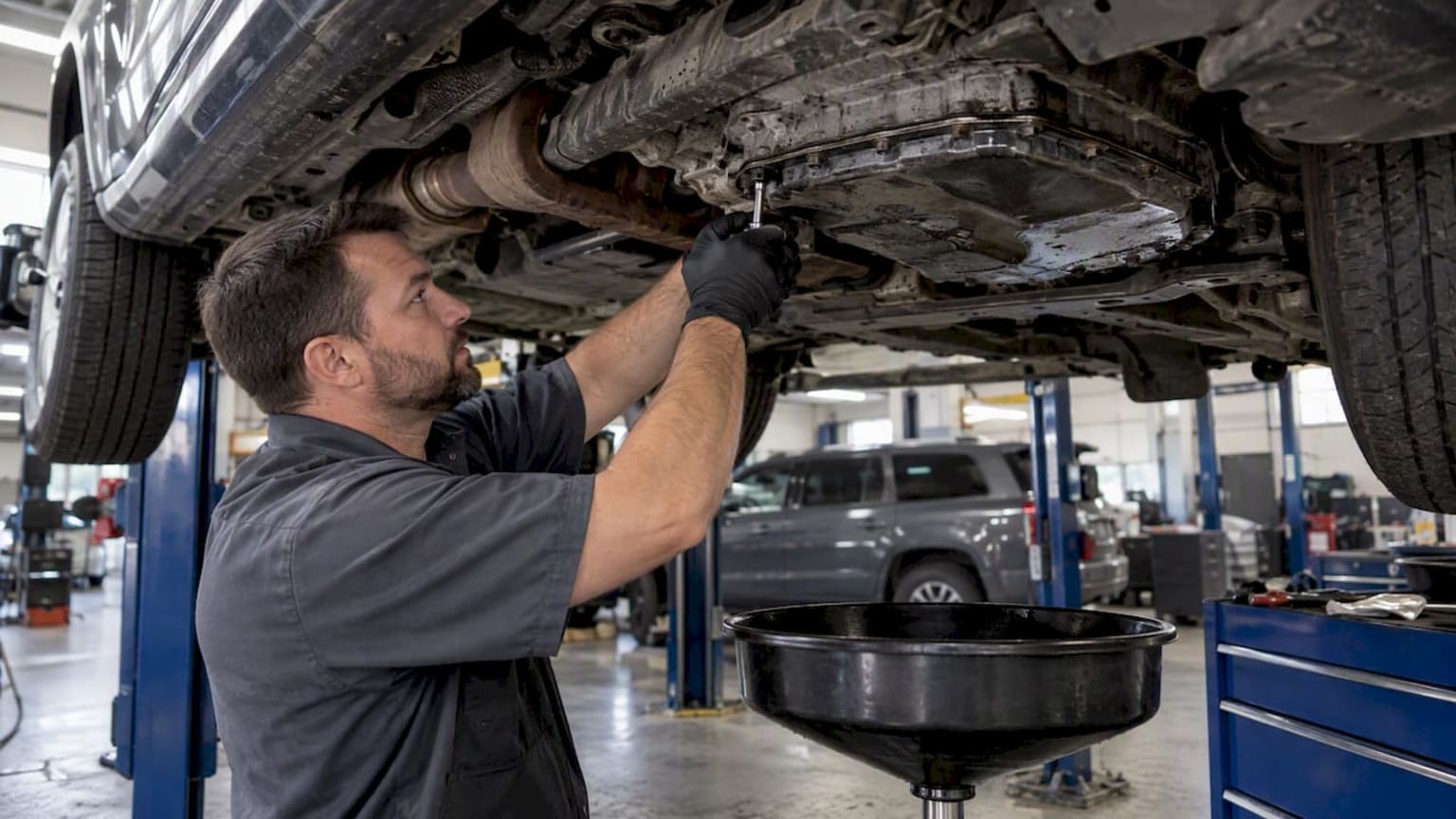
Durango Transmission Service Interval: When to Change the Fluid
For most Dodge Durango owners, a transmission fluid and filter service every 60,000 to 80,000 miles is a sensible target. Independent specialists recommend that range, and it is shorter if you tow, haul heavy loads or drive in stop-and-go heat. Dodge’s own paperwork is vaguer than most owners expect, so the honest answer is a range, not a single number. This guide explains why the numbers differ, how to choose yours, what the service costs, and what it does to your warranty.
Libertychryslerdodgejeep
libertychryslerdodgejeep.com
Keep Your Durango Running Smoothly
Liberty Chrysler Dodge Jeep Ram provides professional vehicle service to help you care for your Durango’s transmission and other maintenance needs.
TL;DR
Official Durango manuals often give no firm mileage for replacing automatic transmission fluid, so the “sealed, lifetime” label should not be read as “never.”
Independent specialists typically recommend a fluid and filter change every 60,000 to 80,000 miles. Towing, heat and heavy city use argue for the low end.
A professional fluid change ran about $423 to $497 in 2023 estimates, parts and labor combined. A valve body or solenoid repair can cost $400 to $1,000 or more.
Use the fluid the transmission is specified for, keep every receipt, and make sure the adaptive relearn is done afterward.
If you are past 100,000 miles with no service history, have a technician look at the fluid before you decide.
Table of Contents
Why the Durango transmission interval is so hard to pin down
Shopping for a Durango? Check the transmission history first
Why the Durango transmission interval is so hard to pin down
Search this topic and you will see numbers from 30,000 to 90,000 miles, plus forum posts that say “never touch it.” The spread has real causes.
First, the Durango has been sold with different automatics across generations. Recent model years use an 8-speed automatic, and Mopar sells a dedicated ZF 8 and 9 speed ATF for that family of transmissions. Older Durangos use different units and different fluid. A number quoted for one does not transfer to another.
Second, manufacturers describe these units as sealed. That word refers to the design: there is no dipstick for you to check. It does not mean the fluid stops aging. Industry specialists are clear that sealed units are not maintenance-free, and that ignoring them until something fails often ends in expensive damage.
Third, “normal” and “severe” use change the answer. A Durango that commutes on a highway and a Durango that pulls a boat up a hot boat ramp every weekend are not on the same schedule, even with identical badges.
So treat any single figure you read, including ours, as a starting point to adjust for your vehicle and how you use it.
What the owner’s manual and warranty documents tell you
Start with the paperwork in your glovebox or the free digital copies on Mopar’s owner site. The manual for your exact model year and engine is the authority for your vehicle, and it can change from year to year.
Two points in Dodge’s warranty booklet matter for transmission care:
The owner carries the maintenance responsibility. The warranty information says FCA US LLC provides a maintenance schedule, but the owner must make sure the service gets done. If there is a dispute, FCA may require proof that the vehicle was properly maintained according to the service intervals in the owner’s manual.
Maintenance is not a warrantable item. The Powertrain Limited Warranty covers the transmission case, internal parts, torque converter and control module for up to five years or 60,000 miles, whichever comes first, when the problem is defective materials or workmanship. It excludes maintenance items and normal wear.
In plain terms: if you are inside 60,000 miles and something internal fails, the warranty may respond. If fluid was never serviced and the shop finds worn or wrong fluid, expect questions. After that window, you are paying for whatever happens, which is the best argument for the service.
The same warranty document notes that Federal Emission Warranties may add 8-year/80,000-mile coverage on specific parts such as the transmission valve body and the transmission control module. Read the exact wording for your year before counting on it.
Interval by driving style
Use the table as a planning guide, not a rule. It blends the specialist range quoted above with common-sense adjustments for harder use. Where your manual gives a different figure for your model year, the manual wins.
How you use the Durango | Reasonable service point | Why |
|---|---|---|
Mostly highway, no towing, moderate climate | 60,000 to 80,000 miles | The specialist range applies as written |
Daily stop-and-go commuting, hot summers | Toward 60,000 miles | Heat and constant shifting age the fluid faster |
Regular towing or hauling near the vehicle’s limit | Toward 60,000 miles or sooner; ask a technician | Load raises fluid temperature, the main enemy of ATF |
Bought used, no service records | Inspect now, service soon | You cannot prove what was done, and neither can a warranty reviewer |
Past 100,000 miles, never serviced | Technician inspection first | A first-ever change on a very high-mileage unit deserves a look at the fluid and the pan before anyone drains it |
That last row prompts the most argument online. Owners post both stories: “I changed it at 120,000 and it was fine” and “I changed it and it started slipping.” Neither anecdote proves a rule. What matters is the condition of the fluid and the transmission, and a technician can assess both in minutes. If the unit is already worn, a fluid change will not repair it, but it also will not usually be the cause of the wear.
What a Durango transmission service includes
A proper service is more than “drain and fill.” Ask what is included before you agree to a price.
Fluid drain and refill with the correct specification. Not “universal” fluid. For the 8-speed, that means Mopar ZF 8 and 9 Speed ATF or an authorized equivalent. Generic fluids can cause erratic shifting and premature clutch material wear, and improper fluid, if identified, can complicate a warranty claim.
Pan and filter. If your transmission has a serviceable filter, it should be replaced at the same visit. This is why a “fluid only” quote from a quick-lube shop is not the same product as a pan-and-filter service.
Temperature-controlled fill level. Sealed transmissions are filled and checked at a specific fluid temperature, usually with a scan tool. Guessing by volume is how units end up overfilled or low.
Adaptive relearn. After new fluid, the control module should be allowed to relearn shift behavior for the cleaner, differently behaving fluid. Mopar’s guidance points to the relearn as part of doing the job right.
Inspection. A technician should look at the old fluid color and smell, check for leaks at the pan and seals, and scan for stored transmission codes.
FCA also points out that factory-trained technicians have specific tools and knowledge, including the ability to carry out electronic module resets, which some independent shops lack. That is the main practical reason to bring a late-model Durango back to a Dodge dealer for this job.
What it costs, and what it saves
In 2023 estimates from Kelley Blue Book, a professional transmission fluid change on a Durango ran between $423 and $497: about $190 to $224 in parts and $233 to $273 in labor. Your price will vary with the year, region and whether the quote includes the pan and filter. Treat those figures as a ballpark rather than a quote.
Compare that with the failure side. Specialists put the cost of fixing a solenoid pack or valve body problem at roughly $400 to $1,000, while a full replacement unit costs thousands. The fluid service is not a guarantee against any of that, but it is the cheapest lever you control.
We do not publish service prices online, so for an accurate number on your Durango, ask our service team for a quote based on your VIN and mileage.
Warning signs that should not wait for the interval
Mileage is a guide. Symptoms are a verdict. Book a visit sooner if you notice:
Harsh, delayed or flaring shifts, especially between gears while accelerating
A shudder at steady highway speed
Slipping, where the engine revs but the SUV does not respond
Red or brown fluid spots under the front half of the vehicle
A burnt smell after towing or a long climb
A check engine light or a transmission warning message
Do not keep driving through slipping or overheating. Heat does the damage fast, and a tow to the shop costs far less than a rebuilt unit. If the issue appears during your warranty period, tell the dealer before any other shop opens the transmission. Roadside assistance for covered vehicles also includes towing to the nearest authorized Chrysler, Dodge, Jeep or Ram dealer when a covered part has failed and the vehicle cannot be driven.
Where to have it done, and how to protect your warranty
You are not legally forced to use the dealer for routine maintenance. But the booklet makes the stakes plain: if a dispute arises, the paper trail decides it. Whoever does the work, keep:
An itemized invoice with date and odometer reading
The fluid specification or product name on the invoice
Proof that a pan and filter service was done, if applicable
Notes on towing or heavy use, in case you need to explain a shorter interval
If you do the work yourself, keep receipts for the fluid and filter kit and a log of the date and mileage. Without the electronic relearn and fill-temperature check, a DIY job on a modern 8-speed is harder to get right than it looks.
Our perspective: treat “sealed” as “service on a schedule”
We are a family-focused dealership, and we would rather you spend a few hundred dollars at 70,000 miles than come back with a tow ticket at 110,000. The ugly part of this topic is that nobody gains from confusion. The manual is quiet, the forums are loud, and owners end up guessing.
Here is how we would handle your Durango:
Pick the interval from how you drive, not from the odometer alone. If the Durango tows or lives in heavy traffic, plan on the early end of the range.
Buy used with the records in hand. A Durango with documented fluid service is worth more to us and to you than one with a clean carpet and no history. If records are missing, factor a transmission inspection into the price.
Use the correct fluid, every time. The fluid is cheap compared with what it protects. This is the one place we would not cut corners.
Keep it simple. One visit, one invoice, one clear explanation of what was done and why. That is how we want every service appointment to go.
If you are not sure what your Durango has had done, bring it in and we will tell you plainly what we see.
— michael
Shopping for a Durango? Check the transmission history first
If you are reading this because you are weighing a used Durango, the service record is as important as the mileage. Our certified Dodge inventory and used vehicle listings are a good place to start, and our certified pre-owned program is built for buyers who want extra assurance. Recent examples at our Hinesville, Georgia store have included a 2025 Durango R/T Plus AWD, a 2024 Durango SXT AWD and a 2019 Durango R/T RWD. Inventory changes, so check what is on the lot today.
Already own a Durango that is due for service? Schedule it with our service center and we will look at the fluid, the pan and any stored codes. If you are thinking about moving out of an older Durango, our trade-in valuation page starts the process, and our financing team can walk you through the next vehicle. For fluids and parts, we stock genuine Mopar parts and accessories.
Other maintenance to bundle with the transmission service
A transmission visit is a good time to look at the rest of the drivetrain, since you will already have the vehicle on the lift.
Transfer case fluid (AWD models). Some maintenance schedules pair transfer case service with heavy-use transmission service. Check your manual for your drivetrain.
Brakes. Heavy SUVs wear brakes faster, especially with towing. Our guide to maintaining Dodge performance vehicle brakes covers what to watch for.
A wider service-interval check. Our article on service interval recommendations is written for Jeep, but the habit it teaches, matching intervals to real use, applies to any Chrysler, Dodge, Jeep or Ram.
Cooling system. Transmission heat is partly an engine-cooling issue. A tired radiator or low coolant makes everything run hotter.
FAQ
How often should I change the transmission fluid in my Dodge Durango?
A good working range is every 60,000 to 80,000 miles for fluid and filter, per independent specialist guidance. Move toward 60,000 miles if you tow, haul or drive in heavy traffic and heat. Your owner’s manual for your exact model year is the final word.
Is the Durango transmission really “sealed for life”?
No. “Sealed” means there is no dipstick, not that the fluid never degrades. Specialists warn that sealed units are not maintenance-free, and the warranty excludes maintenance items and normal wear.
Does changing the fluid void my Durango warranty?
Proper service does not hurt your coverage, and skipping it can. FCA says the owner must keep the vehicle maintained and may ask for proof of service in a dispute. Using the wrong fluid is the real risk, so keep receipts that show the specification.
How much does a Durango transmission fluid change cost?
Kelley Blue Book’s 2023 estimates put a professional fluid change at $423 to $497 including parts and labor. Actual prices vary by year, region and whether a pan and filter are included, so ask for a written quote.
Should I change the fluid on a Durango with over 100,000 miles and no history?
Have a technician inspect the fluid and scan for codes first. If the fluid is in decent shape and shifting is smooth, a service is usually a reasonable step. If there are slipping or shuddering symptoms, the problem needs diagnosis rather than fresh fluid alone.