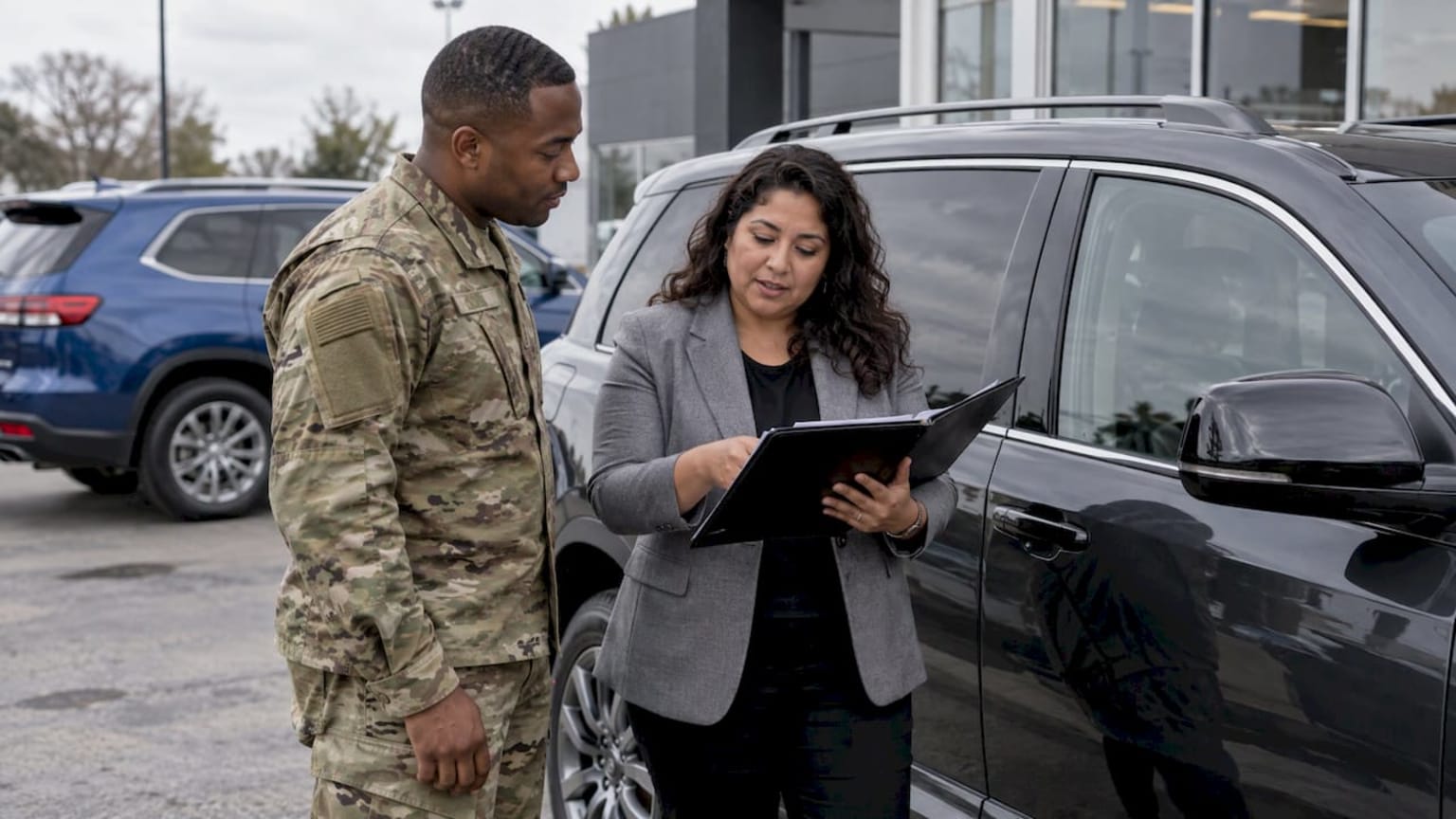
Military Auto Financing: Rights, Rates and How to Apply
Military auto financing is an ordinary car loan with some extra protections and, at some lenders and dealerships, extra incentives. The protections come from federal law and depend on when you signed the loan. The incentives depend on who you borrow from. At Liberty Chrysler Dodge Jeep Ram, we support military families with special incentives and can set up new and used vehicle financing around your orders, your budget and your timeline.
This guide covers who qualifies, what the law does and does not protect, the numbers to compare before you sign, and how the application works from start to finish.
Libertychryslerdodgejeep
Explore Financing for Your Next Vehicle
Liberty Chrysler Dodge Jeep Ram helps customers find vehicle financing, with support for military families shopping around their needs and timeline.
TL;DR
Active-duty members, reservists, National Guard members, veterans and often their families can use military-focused financing. Exact eligibility depends on the program, so ask what proof of service is required.
The Servicemembers Civil Relief Act (SCRA) can cap interest at 6% and require a court order before repossession, but only on loans that began before active duty.
The Military Lending Act does not cover loans that finance a vehicle purchase, so compare the total cost of the loan yourself.
Judge any offer on APR, term, total amount payable and penalties, not on the monthly payment alone.
Ask about military incentives before you negotiate, and get financing and trade-in numbers in the same visit.
Table of Contents
Who qualifies for military auto financing
The category is wider than most people expect. Programs typically recognize active-duty members of every branch, reservists and National Guard members, veterans and retirees, and in many cases a spouse or dependent. Each lender or dealer sets its own rules, so the first question to ask is simply: “What proof of service do you need from me?”
That proof usually comes from the documents you already have. Active-duty members commonly use a military ID and a Leave and Earnings Statement (LES) to show income. Veterans commonly use discharge papers (DD214) and recent pay stubs or retirement income statements. Bring tax returns or W-2s if you have them, plus contact details for a spouse or family member, since lenders often ask.
Two points about eligibility are worth knowing before you shop:
Incentives and legal protections are separate things. A dealership incentive is a business offer. The SCRA is federal law. You can qualify for one without the other.
Your status on the day you sign matters. Whether you were already on active duty when the loan began changes which federal protections apply, as the next section explains.
If you are near Fort Stewart or anywhere else in the region, our military incentives page is the place to see what we offer service members and their families.
What the law protects, and what it does not
Most of the confusion around car loans for military borrowers comes from two similarly named laws. They protect different people at different moments.
The Servicemembers Civil Relief Act (SCRA)
The SCRA protects obligations you took on before you entered active duty. According to the Consumer Financial Protection Bureau, you can lower the interest rate on a pre-service auto loan to 6 percent. To get that benefit you notify your lender in writing and include a copy of your orders or a letter from your commanding officer. You can make the request while serving or up to 180 days after release.
The details matter:
The cap is forgiveness, not deferral. In a 2022 joint letter to the auto industry, the CFPB and Justice Department said that after a proper request, a creditor must forgive interest above 6% a year, back to the first day of SCRA eligibility.
Repossession needs a court order. If you financed or leased the vehicle before entering military service, the same letter says the finance company may not repossess it during your service without a court order. It also says you do not have to give notice of military status to get this protection.
It does not reach loans signed on active duty. The CFPB’s January 2025 report on auto lending to service members states that if you took out an auto loan while on active duty, the 6 percent cap does not apply.
Leases have their own rule. The FDIC’s SCRA examination manual says a lease entered into on active duty may be terminated if you receive orders for a PCS outside the continental United States, including Hawaii or Alaska, or a deployment of 180 days or more. It also says the vehicle must be returned to the lessor within 15 days after written notice of termination.
This is the practical reading: if you are a new recruit with a car loan you signed as a civilian, the SCRA can help. If you are already in uniform and shopping now, the SCRA rate cap will not apply to the loan you are about to sign, so the terms you choose today carry more weight.
The Military Lending Act (MLA)
The MLA caps the cost of many consumer loans at a 36 percent military annual percentage rate. But the Department of Defense’s final rule announcement states that purchase-money loans, including a loan to finance buying a vehicle, are excluded from the definition of consumer credit. The CFPB’s applicability flow chart says the same about credit expressly meant to finance a motor vehicle purchase and secured by that vehicle.
In plain terms, the MLA’s rate ceiling is not your safety net on a dealership auto loan. If you want to understand where the MLA does apply, this explainer on the Military Lending Act and title loans lays out the other loan types it covers. For a vehicle purchase, your protection comes from comparing terms carefully and from the SCRA where it applies.
How military financing differs from a standard auto loan
The underlying product is the same: you borrow against the vehicle and repay with interest over a set term. What can change is the package around it. Depending on the lender and program, military-focused financing may include a modest rate reduction, flexible down payment requirements, or longer terms. Those features are offered at each lender’s discretion, not guaranteed by law, so ask for them by name.
Military OneSource, the Department of Defense’s support service, says in its car-buying guide that you should decide how much to pay upfront, consider a trade-in, seek preapproval, and compare offers on interest rate, APR, term, payment, total cost, penalties, optional products and prepaid items. That list is a good template for any financing conversation, and we would encourage you to bring it to ours.
At Liberty Chrysler Dodge Jeep Ram, financing, trade-in support and military incentives sit under one roof for Chrysler, Dodge, Jeep and Ram vehicles. That means one visit can answer three questions together: what your trade is worth, what incentives apply to you, and what loan structure fits your pay.
The numbers to compare before you sign
A monthly payment is the number everyone asks about, and the least reliable way to judge a loan. The CFPB warns in its guidance for servicemembers that a smaller payment may mean a longer loan, 72 months or more instead of 36, 48 or 60, and that you should look at total financing cost, not only the payment.
Use this checklist on every offer, ours included:
What to check | Why it matters |
|---|---|
Amount financed | The price, taxes and fees minus your down payment and trade-in value. Confirm each piece. |
APR | Combines interest and certain fees into one comparable yearly rate. |
Term in months | A longer term lowers the payment but raises the total paid. |
Monthly payment | Make sure it fits your pay after allotments and housing costs. |
Total amount payable | The honest bottom line across the life of the loan. |
Penalties | Ask about late fees and whether paying early costs anything. |
Optional products | Warranties, service plans and GAP coverage should be your choice, with prices stated separately. |
Prepaid items | Anything rolled into the loan increases what you finance. |
The CFPB also advises checking your credit reports before you apply, so you know how lenders are likely to see you, and asking about any military-specific discounts. Our blog on raising your credit score or applying now helps you decide which makes sense for your timing.
A worked example of why term matters
Take a hypothetical $30,000 loan at a 7% APR. This is an illustration with made-up numbers, not a quote. Over 60 months the payment is roughly $594 and total interest about $5,650. Stretch the same loan to 84 months and the payment falls to roughly $453, but total interest climbs to about $8,050. You would pay around $2,400 more to save about $140 a month. For some budgets that trade is worth it, particularly around a PCS move. For others it is not. Seeing both columns side by side is how you choose on purpose instead of by default.
Get pre-approved first
Preapproval turns a vague budget into a number. It tells you what you can borrow and at what rate before you fall for a particular truck or Jeep. We explain the process in our guide to getting pre-approved for a car loan before you shop, and you can apply for financing online from home or from the barracks.
Two habits make preapproval work for you:
Set your ceiling first. Pick a maximum monthly payment and a maximum term before you step onto a lot. Salespeople shape offers around the payment you reveal, so decide it in advance.
Ask for the full breakdown in writing. Amount financed, APR, term, total payable and every added product, itemized. A clear written offer is easy to compare and easy to trust.
First-time buyers, including many young service members buying their first vehicle, can start with our explanation of how a first-time buyer car loan works.
How the application works, step by step
Check your credit and set a budget. Pull your reports and decide the payment you can carry through a deployment, a PCS or a change in housing allowance.
Gather documents. Proof of service and proof of income, as listed above, plus a driver’s license and insurance information.
Apply. Our dealer financing buyer’s guide walks through what the application asks and why. You can submit it through our financing application.
Price your trade. A trade-in lowers the amount you finance. Our trade-in valuation page is where that starts.
Ask about military incentives. Our military discount page and the guides on military car rebates and the Jeep military discount explain how incentives are claimed, so you apply them to the right part of the deal.
Compare the final numbers. Run the checklist above on the written offer before you sign.
Timing around orders, deployment and PCS
Military life changes the questions a civilian never has to ask. A few worth raising with whoever writes your loan:
Where will the vehicle be in a year? A longer loan on a vehicle you may have to ship or sell after a PCS leaves less room if the loan balance is higher than the vehicle’s value.
Who can handle the account while you are away? Confirm how a spouse can make payments or reach the lender during a deployment.
Is a lease right for your orders? The SCRA lease termination rule described earlier only covers leases that meet its conditions, so read the conditions before relying on it.
Are you about to enter active duty? If you are a recruit or a cadet buying before you report, a loan signed now may qualify for SCRA protections later. Keep your paperwork and notify your lender in writing when your orders arrive.
What about refinancing later?
Refinancing means replacing your current auto loan with a new one, ideally at a lower rate or with a more comfortable term. It tends to make sense when your credit has improved since you bought, or when the rate you accepted was high to begin with. Two cautions from the same logic as above: extending the term to cut the payment can raise total interest, and the SCRA’s 6% cap applies to the original pre-service obligation, so check how a refinance might affect it before replacing a loan that qualifies. If you signed with us, ask us first, because we can review your current terms with you.
Our perspective
We built our approach around a simple idea: a military family should not have to decode a car deal. Orders arrive on their own schedule, and a vehicle purchase has to fit around them.
That is why we put financing, trade-in support and military incentives in one conversation. When the people who value your trade also explain your incentives and your loan, the numbers line up, and you can see the whole deal instead of one piece at a time.
Our advice is to bring your budget, your documents and your questions. Ask about APR, term and total cost. Ask what incentives apply to you. A straightforward, personal answer to each is what we want to give, and it is how we hope to earn a long relationship, not a one-time sale.
michael
Ready to start
If you are a service member, veteran or military family looking at a Chrysler, Dodge, Jeep or Ram, our team can walk you through financing, your trade-in and military incentives together. Start with our financing page, then browse new vehicles, used vehicles or certified pre-owned options.
After the sale, our service center and genuine Mopar parts keep the vehicle you financed running well.
FAQ
Do military members get lower auto loan rates?
Not automatically. Some lenders and dealerships offer military discounts or special programs, and others do not, so you have to ask. Federal law gives a 6% cap only on loans that began before active duty. Ask us what applies to you at our military incentives page.
Can veterans use military auto financing?
Often yes. Many programs include veterans and retirees, usually with discharge or retirement documents. Some also include family members. Eligibility is set by each program, so confirm which proof of service is needed before you apply.
Does the Military Lending Act cap my car loan rate?
No, not for a loan that finances a vehicle purchase. The Department of Defense states that purchase-money vehicle loans are excluded from the MLA’s definition of consumer credit. That makes comparing APR, term and total cost yourself the best protection.
What happens to my car loan if I am deployed?
If the loan began before active duty, the SCRA can cap the rate at 6% when you notify the lender in writing with your orders, and the lender needs a court order to repossess. Loans signed while on active duty do not get the rate cap. Contact your lender early, and for legal questions talk to a military legal assistance office.
What should I bring to apply?
Bring proof of service such as a military ID or DD214, proof of income such as an LES or pay stubs, a driver’s license, and insurance information. Having them ready keeps the application quick.
Sources
Tips for Buying a Car While in the Military, Military OneSource
Servicemembers Civil Relief Act (SCRA), Consumer Financial Protection Bureau
Servicemembers, arm yourself with basic car buying skills, CFPB
Department of Defense Issues Final Military Lending Act Rule