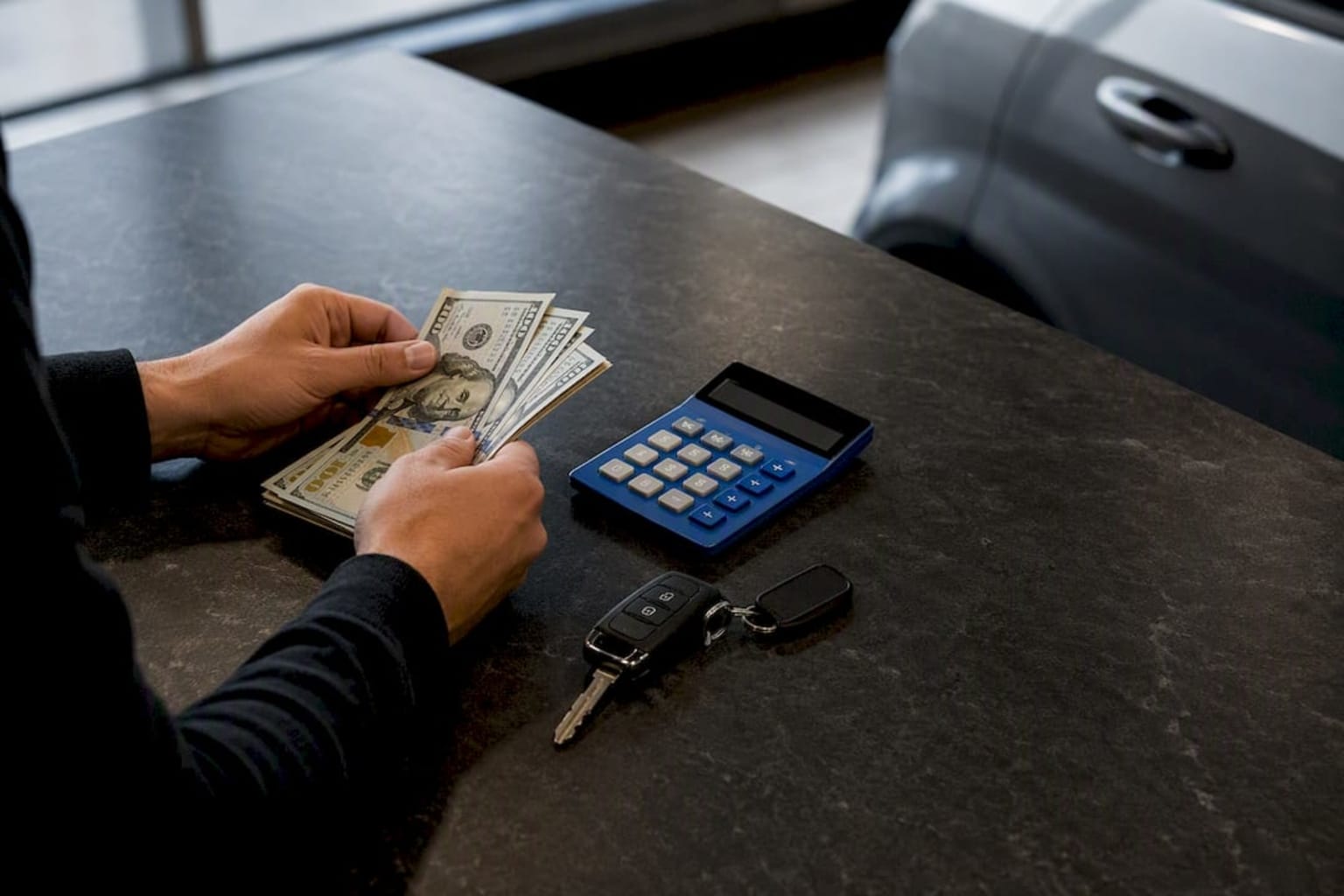
Aim for 10–15%: Car Loan Down Payment U.S. Buyers Can Test With Dealer Tools
Put 20% down on a new car and 10% on a used one if you can swing it without draining savings. Most buyers can’t hit that anymore, so a realistic target is 10% to 15% of the out-the-door price. A bigger down payment cuts your monthly bill and your interest rate, but an empty emergency fund is a worse trade than a slightly higher car payment.
TL;DR:
Putting at least 10% to 15% down generally helps limit depreciation risk, but most buyers finance more than that, often with longer loan terms.
Trade-ins and manufacturer rebates can cover part or all of your down payment, but negative equity from trade-ins adds to your loan if you owe more than your car is worth.
A larger down payment reduces your loan-to-value ratio, lowering the risk of being underwater early in the loan, especially on long-term financing over 72 months.
Stretching loans to 72 or 84 months makes small down payments riskier, as it keeps your LTV high longer and increases total interest paid.
For leasing, a large upfront down payment rarely provides benefit and can be lost if the vehicle is totalled early, so keep lease drive-off costs minimal.
Table of Contents
What Counts Toward Your Car Loan Down Payment
Your down payment isn’t just cash from your bank account. It’s cash plus trade-in equity plus any manufacturer rebates, all applied against the out-the-door (OTD) price, not the sticker number you see on the windshield. OTD includes sales tax, title fees, registration, and dealer add-ons, so it’s almost always higher than the advertised price.
Trade-ins get netted, not added directly. If you still owe money on the vehicle you’re trading, the dealer applies its value to your remaining loan payoff first. Only what’s left over counts as usable down payment.
A few things trip people up:
Paying part of your down payment with a credit card often triggers a convenience fee from the dealer.
Taxes and registration fees baked into the OTD price can eat into what you thought was your down payment cushion.
Manufacturer rebates reduce the amount financed, but they don’t always stack with 0% APR promotions.
How Much Do People Actually Put Down in 2026?
The 20% new, 10% used rule exists because vehicles depreciate fastest in the first year or two of ownership. Putting more down keeps your loan-to-value ratio (LTV) low enough that you’re not underwater the moment you drive off the lot, according to the Consumer Financial Protection Bureau. Industry guidance from CNBC Select still recommends this split for exactly that reason.
Average new-vehicle down payment: $5,815 (about 11.6% of purchase price), according to Edmunds’ Q2 2026 data. That’s well short of the traditional 20% benchmark, and it’s paired with longer loan terms and more total interest paid over the life of those loans.
A smaller down payment can work fine if:
Your credit score is strong enough to qualify for a low APR regardless of how much you put down.
You’re taking advantage of a genuine 0% promotional financing offer from the manufacturer.
Your loan term is short (48 to 60 months), which limits how long you’re exposed to depreciation risk.
Be more cautious with a thin down payment if you’re stretching to a 72 or 84-month term, or if your credit sits in the fair-to-poor range, where lenders lean harder on down payment size to offset risk.
How Down Payment Size Changes Your APR, Payment, and Risk
A bigger down payment does three things at once: it shrinks the amount you finance, it can lower the APR a lender quotes you, and it improves your approval odds if your credit isn’t pristine. The CFPB notes that borrowers with FICO scores around 620 or below often see the biggest swing in approval likelihood tied to down payment size.
As a rough guide, every extra $1,000 down shaves roughly $18 to $22 off your monthly payment on a 60 month loan at a typical rate, though the exact number moves with your APR and term. Stretch the loan to 84 months and that monthly savings shrinks, even though your total interest paid climbs.
Loan-to-value matters here. Finance a $30,000 car with only $1,500 down (5%) and you’re borrowing at 95% LTV. Total a car like that six months in, and your insurance payout based on depreciated value likely won’t cover the loan balance. That gap is where buyers get stuck owing money on a car they no longer have.
Higher down payment = lower LTV = less upside-down risk in year one.
Longer terms (72 to 84 months) keep LTV elevated longer, according to CarSavr’s guide, so pairing a long term with a small down payment compounds risk.
Your debt-to-income ratio (DTI) interacts with down payment too. A larger down payment can offset a higher DTI in a lender’s eyes.
Pro Tip: Run the same loan amount through a payment calculator at both 60 and 72 months before you sign anything. The monthly savings from stretching the term rarely justifies the extra interest you’ll pay over time.
Using Trade-Ins and Rebates to Boost Your Down Payment
You don’t need a pile of cash to hit a solid down payment target.
If your trade-in is worth more than you owe, that difference rolls straight into your down payment evaluation. If you owe more than it’s worth, that’s negative equity, and it gets added to your new loan rather than helping you. A step-by-step trade-in guide walks through how to get an accurate payoff figure before you commit.
Manufacturer rebates reduce the OTD price directly, which lowers how much you need to finance in the first place.
Avoid draining your emergency fund to hit a down payment target. A slightly higher monthly payment beats having zero savings cushion.
Skip high-interest credit cards for a down payment. The card’s APR will almost always beat any savings you get on the loan.
Why a Big Down Payment on a Lease Is Usually a Mistake
Leases work differently than loans, and the down payment logic that applies to buying can actually hurt you when leasing. A lease down payment (often called a capitalized cost reduction) lowers your monthly payment, but it’s tied to the vehicle’s depreciation, called the residual value, not equity you build.
Here’s the catch: if the leased vehicle is totaled or stolen early in the term, insurance typically pays only the car’s actual cash value. Whatever you put down upfront is usually gone, since KBB’s leasing guidance notes that large drive-off payments are rarely recoverable in a total-loss claim.
Keep lease drive-off costs to first month’s payment, taxes, and fees only.
Take a slightly higher monthly payment instead of a large cap cost reduction.
Gap insurance still matters on a lease, since it covers the difference between what you owe and what insurance pays out.
A small cap reduction can make sense if it gets you under a specific monthly payment threshold your budget requires.
The 20/4/10 Rule and Other Guardrails for Picking Your Down Payment
It’s a strict standard, and most 2026 buyers aren’t hitting it, but it’s worth measuring yourself against.
If 20% isn’t realistic, CarSavr’s research points to 10% to 15% of the OTD price as a workable middle ground for buyers with decent credit, especially on loan terms of 60 months or less.
Keep at least three months of living expenses in reserve before you touch savings for a down payment.
Push for a larger down payment (closer to 20% to 25%) if you’re financing for 72 months or longer, since that’s where upside-down risk peaks.
Push for a larger down payment if your credit score is below the low 600s. It directly improves your approval odds.
If your down payment ends up under 10%, budget for gap insurance. It typically adds a modest amount to your premium but protects you during the 12 to 24 months you’re most likely to be underwater.
Pro Tip: If you’re a first-time buyer without a trade-in, a slightly smaller down payment paired with gap insurance often costs less overall than delaying your purchase for months to save up an extra few thousand dollars.
Worked Examples: Comparing Down Payment Scenarios
Numbers make this concrete.
10% down ($3,000): You finance $27,000, landing around $535 a month.
15% down ($4,500): You finance $25,500, dropping to roughly $505 a month.
20% down ($6,000): You finance $24,000, closer to $475 a month.
To test your own numbers, plug the OTD price, any trade-in value, your expected APR, and loan term into a payment calculator. Adjust the down payment field alone and watch how the monthly payment and total interest shift.
How Liberty CDJR Helps You Nail Down the Right Number
You don’t have to run these numbers alone. Liberty CDJR’s financing team works with buyers to figure out a down payment that fits their actual budget, not just a textbook percentage.
Test scenarios yourself with the dealership’s payment calculator before you ever step onto the lot.
Get a real trade-in evaluation so you know your net equity before you shop.
Ask about warranty options and military family incentives, which can affect how much cash you need upfront.
Getting pre-approved before your visit clarifies exactly what down payment a lender expects, so you’re not guessing.
Ready to See What Your Down Payment Could Look Like?
Liberty CDJR’s financing application gets you a real answer on down payment and monthly payment before you set foot on the lot, not a generic estimate pulled from a national average. Bring a trade-in, and the team applies its net value directly against your down payment target, no separate appraisal trip required.
Military families get access to special incentives that can lower the cash needed upfront, and the payment calculator lets you test 10%, 15%, and 20% scenarios side by side before you decide. Browse new Jeep inventory or used Ram trucks to see real pricing, then apply for financing to lock in the numbers that actually fit your budget.
A Practical Note on Getting This Right
Most buyers overthink the percentage and underthink their own cash flow. Liberty CDJR can run your trade-in and financing numbers together, so you see a real figure before you decide.
— michael