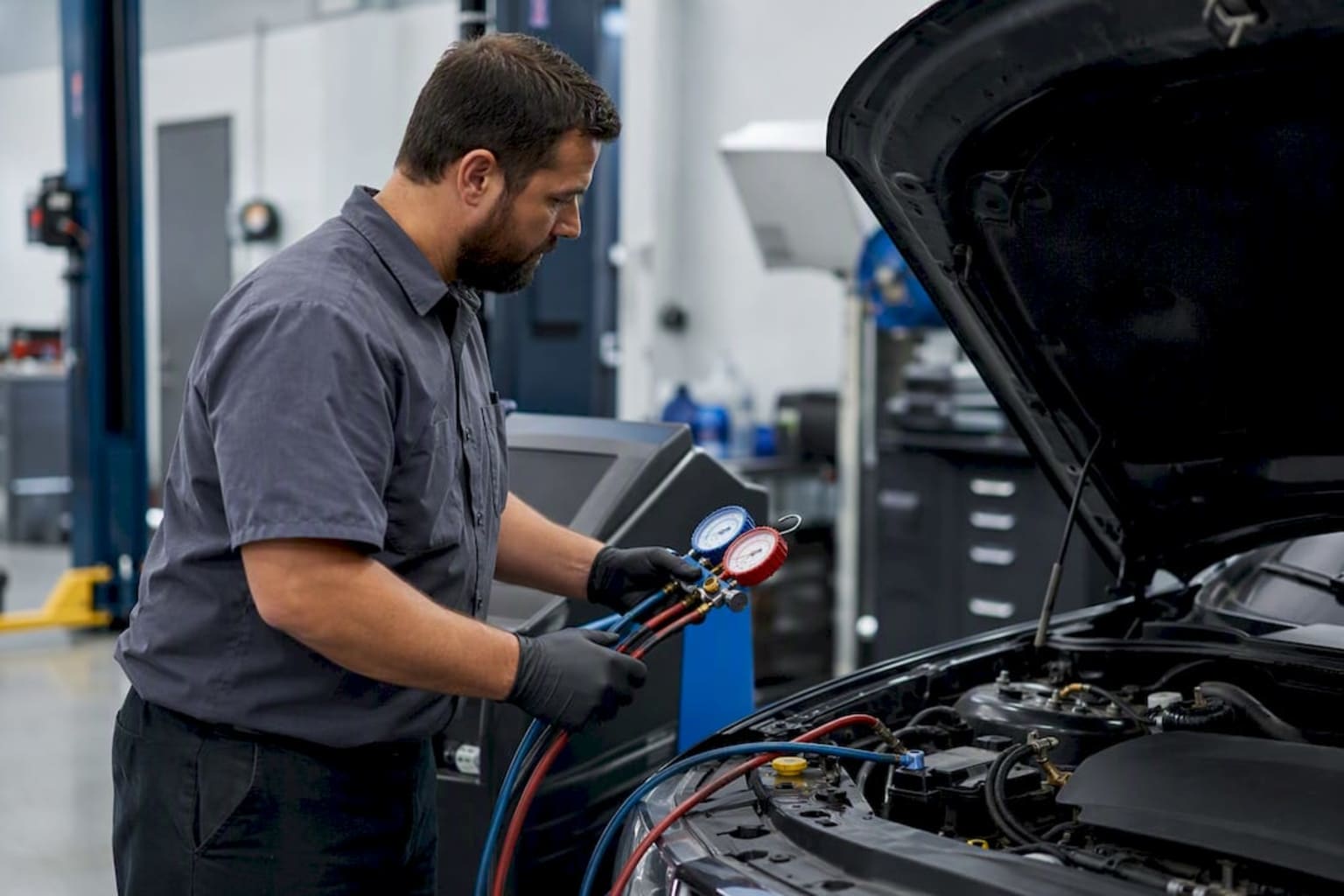
What Determines Your AC Recharge Cost?
Expect moderate to higher prices at a professional shop depending on whether your car uses older R134a refrigerant or the newer R1234yf system found in recent vehicles. DIY kits are lower cost but do not include vacuum testing or leak checks that professional repairs require.
A recharge alone usually solves the problem when cooling faded gradually over months and the compressor still engages when you flip on the AC. If the air went from cold to warm in a matter of days, or you hear hissing under the hood, you’re likely looking at a leak or failed component, not a simple refrigerant top-off.
Professional shop prices for older R134a systems generally fall in a moderate price range.
Prices for newer R1234yf systems at shops are higher for reasons including refrigerant and equipment costs.
DIY kits are available at lower prices but lack leak testing and vacuum pulling.
Key Takeaways
AC recharge cost depends more on refrigerant type and whether the shop performs a vacuum and leak test than on the shop itself.
Point | Details |
|---|---|
Refrigerant type sets the floor | R134a runs $150–$250; R1234yf runs $250–$450 due to higher per-pound refrigerant and equipment costs. |
DIY saves money short-term | Kits cost $40–$130 but skip recovery, vacuum testing, and precise weighing. |
Sudden cooling loss signals repair | Hissing, oily residue, or warm idle air point to a leak or compressor failure, not just low refrigerant. |
Ask for an itemized quote | Confirm vacuum pull, refrigerant weighing, and leak detection are included before you approve work. |
Dealer service fits complex cases | Liberty CDJR handles OEM parts, warranty work, and recall integration alongside AC diagnostics. |
Table of Contents
How Shops Build the AC Recharge Price
Refrigerant is only part of the bill. A typical car holds a certain amount of refrigerant, with per-pound cost varying significantly depending on the refrigerant type. R134a costs less because it’s been around since the 1990s and supply is stable. R1234yf costs more because it requires specialized recovery machines and remains pricier to source, a pattern that mirrors how refrigerant scarcity drives up residential HVAC pricing too.
Labor is the other half of the equation. Most shops bill a flat rate for an AC recharge that includes evacuation, recharge, and a basic leak check, typically taking under an hour once the car is on the lift.
Typical add-on line items:
Refrigerant recovery: $30–$60
Vacuum/pull: $30–$50
UV dye (for future leak tracing): $10–$20
Leak detection: $50–$100
EPA handling fee: $5–$15
These fees explain why a “recharge” quote can range from $150 to $450 even before parts enter the picture, as RepairPal’s cost estimator shows across different shops and regions. A shop skipping the vacuum pull isn’t necessarily cheaper. It often just skips a step that keeps the recharge from failing in a month. Understanding how service department estimates work helps you spot which quotes are complete and which are missing pieces.
Why Does AC Recharge Price Vary By Vehicle?
Refrigerant type tracks almost directly with model year. Most vehicles built before 2016 or so use R134a. Federal rules pushed R1234yf into nearly all new vehicles by 2021, and that refrigerant carries a materially higher per-pound cost along with recovery equipment requirements most independent shops had to buy new to service it.
System size matters too. A compact sedan with single-zone AC needs less refrigerant and less labor than a three-row SUV with rear climate controls and a second evaporator.
Compact/single-zone systems: lower refrigerant volume, faster service
Multi-zone SUVs and trucks: more refrigerant, longer labor time
EVs and luxury models: specialized oils and high-voltage safety procedures often push quotes past $400
Pro Tip: Check your AC compressor sticker under the hood before you call for a quote. It lists the refrigerant type and exact charge amount, which lets a shop quote you precisely instead of guessing.
Manufacturer-specific procedures, like relearning modules after a recharge on some EVs, add labor time that a generic price guide won’t capture.
DIY AC Recharge Kits: What You Save and What You Risk
A DIY kit gets you a can of refrigerant, a gauge, and sometimes a can of stop-leak sealant for $40 to $130. Real savings over a shop visit, but the kit can’t do what a shop does.
No recovery step. Shops pull out old refrigerant and any contaminants first; DIY kits just add on top of whatever’s already in the system.
No vacuum pull. Without pulling a vacuum, trapped air and moisture stay in the system, which can damage components over time.
No precise weighing. Shops charge refrigerant by exact weight; overfilling from a DIY can strain the compressor.
No leak detection. If a leak caused the low charge, a DIY top-off just delays the same problem for a few weeks.
Improperly handled refrigerant also carries EPA and warranty implications, and overcharging a modern AC system can cause mechanical damage that costs far more than the recharge saved.
Signs Your AC Recharge Won’t Last
Some symptoms point straight to a repair, not a refill. Hissing near the firewall or under the hood usually means an active leak. Oily residue around fittings or the compressor shaft is refrigerant oil escaping through a seal. Warm air specifically at idle, that turns cool once you’re driving, often signals a failing condenser or a fan clutch issue rather than low refrigerant. And if cooling drops off again within a few weeks of a recharge, a leak was masked, not fixed, and the refrigerant simply escaped again.
Before you pay for any recharge, ask the shop for a diagnostic leak check and an itemized quote. A recharge on a system with a $150 fitting leak is money spent twice; a recharge on a system that needed a $900 condenser is money spent for nothing.
Sample AC Recharge Estimates and a Shop Checklist
Here’s what three real-world scenarios might look like on paper.
Low estimate (older R134a sedan, no leak): Refrigerant $60, vacuum/pull $35, labor $70, EPA fee $10. Total: roughly $175.
Typical estimate (R1234yf crossover, minor leak found): Refrigerant $140, recovery/vacuum $80, leak detection $75, labor $90. Total: roughly $385.
High estimate (EV or luxury SUV, multi-zone): Specialized refrigerant/oil $220, recovery/vacuum $90, diagnostics $85, labor $120. Total: roughly $515.
Estimate | Refrigerant | Testing/Recovery | Labor | Total |
|---|---|---|---|---|
Low | $60 | $35 | $70 | ~$175 |
Typical | $140 | $175 | $90 | ~$385 |
High | $220 | $175 | $120 | ~$515 |
Before booking, ask the shop four questions: Do you vacuum the system before recharging? Do you weigh the refrigerant to the manufacturer’s spec? Is leak detection included, or is it extra? Will you itemize parts and labor separately? A full recharge with leak testing usually takes 45 minutes to an hour, and most shops back the service with a short warranty, often 30 to 90 days, on the refrigerant charge itself. Reviewing how dealership labor rates work also helps you judge whether a labor line is in a normal range for your area.
When Dealership AC Service Makes Sense
Complex AC diagnostics, especially on newer R1234yf systems or EVs with high-voltage components, are where dealership service earns its keep. Liberty CDJR technicians work with OEM specifications and Mopar parts daily, which matters when a system needs more than a top-off.
Certified technicians trained on your specific make’s AC architecture
OEM parts that match factory tolerances, protecting your warranty
Recall and warranty work handled in the same visit, no guesswork about coverage
A written, itemized estimate before any work begins
If your Ram, Jeep, Dodge, or Chrysler has a recall tied to climate control components, dealer service also folds that into the same appointment, something covered in more detail in how dealership service handles recalls.
What Most Advice Gets Wrong About AC Recharge Pricing
Most articles on this topic treat “AC recharge cost” like a single number you can look up and trust. It isn’t. The real variable isn’t the shop you pick. It’s whether that shop pulls a vacuum and checks for leaks before adding refrigerant, or just tops it off and sends you on your way.
That single procedural difference explains almost the entire spread between a $175 quote and a $450 quote. A shop that skips recovery and vacuum testing looks cheaper on paper and often is cheaper, right up until the refrigerant leaks out again in six weeks and you pay for a second recharge on top of the first.
The conventional advice, “just get it recharged when it stops blowing cold,” skips the diagnostic step entirely. If your AC lost cooling gradually over a season, a proper recharge with leak testing probably fixes it. If it dropped off suddenly, no amount of refrigerant fixes a cracked hose or a dying compressor. Ask for the itemized quote first. The refrigerant type and the testing steps on that quote tell you more than any price range ever will.
— michael
Get Your AC Checked and Fixed Right the First Time
Guessing between a DIY can and a shop that might skip the vacuum test isn’t a great position to be in when it’s 95 degrees out. Liberty CDJR’s service department gives you a written, itemized estimate before any work starts, so you know exactly what refrigerant type, labor, and testing you’re paying for, no surprises on pickup day.
Our technicians work on Chrysler, Dodge, Jeep, and Ram AC systems daily, including the newer R1234yf setups that require specialized recovery equipment most independent shops don’t carry. Military families get access to special service incentives, and if your AC trouble turns out to be a sign your vehicle is due for an upgrade, our new Jeep inventory and new Ram inventory are worth a look too. Schedule an AC diagnostic and recharge appointment through our service page to get a firm quote before any work begins.